Oracle Implementation Services
Oracle, Implemented the Way
Your Business Actually Works
End-to-end Oracle ERP and Cloud implementation, from licensing and design to configuration, data migration and go-live support, delivered by consultants who know the platform and the business processes behind it.
Our Decade long experience, validated in numbers
Enterprise Customers
OVERVIEW
Implementation is where Oracle
projects succeed or fail
An Oracle implementation done well gives your finance, supply chain, HR and operations teams a single source of truth and a platform that scales with the business. Done poorly, it creates a system that is technically live but practically unusable, requiring workarounds that undermine the investment. We implement Oracle the right way: proper business process analysis before configuration, clean data migration, user training built into the delivery plan, and post-go-live support that does not disappear after cutover.
Trusted by Leading Enterprises
WHAT WE DELIVER
Oracle Cloud ERP Implementation
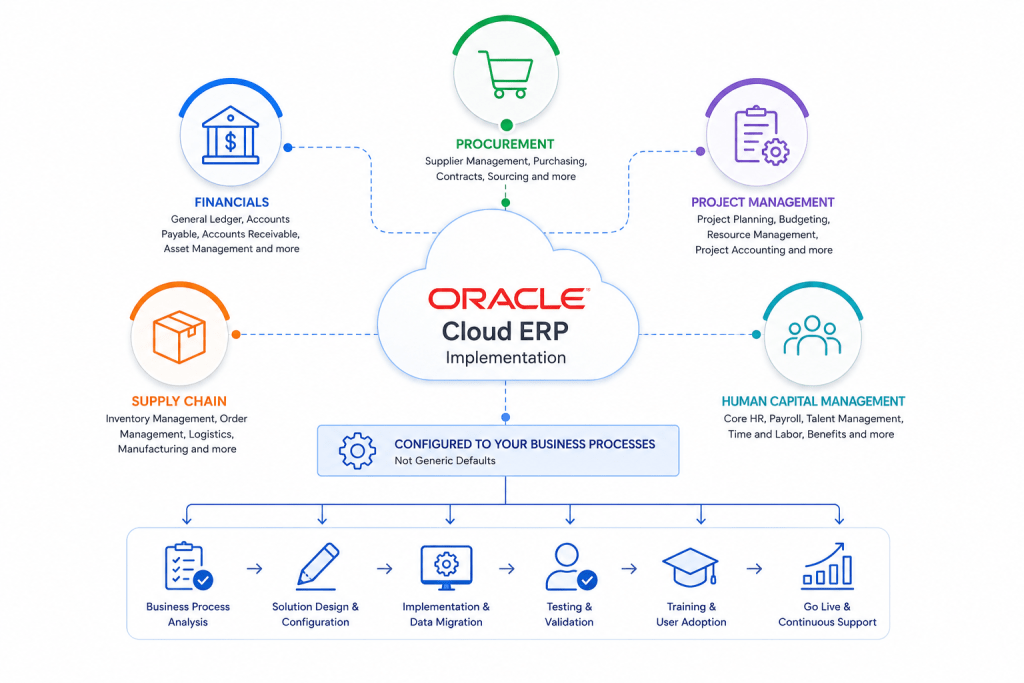
Oracle Cloud ERP Implementation Full implementation of Oracle Cloud ERP modules including Financials, Procurement, Project Management, Supply Chain and HCM. Configured to your business processes, not generic defaults.
Oracle E-Business Suite (EBS)
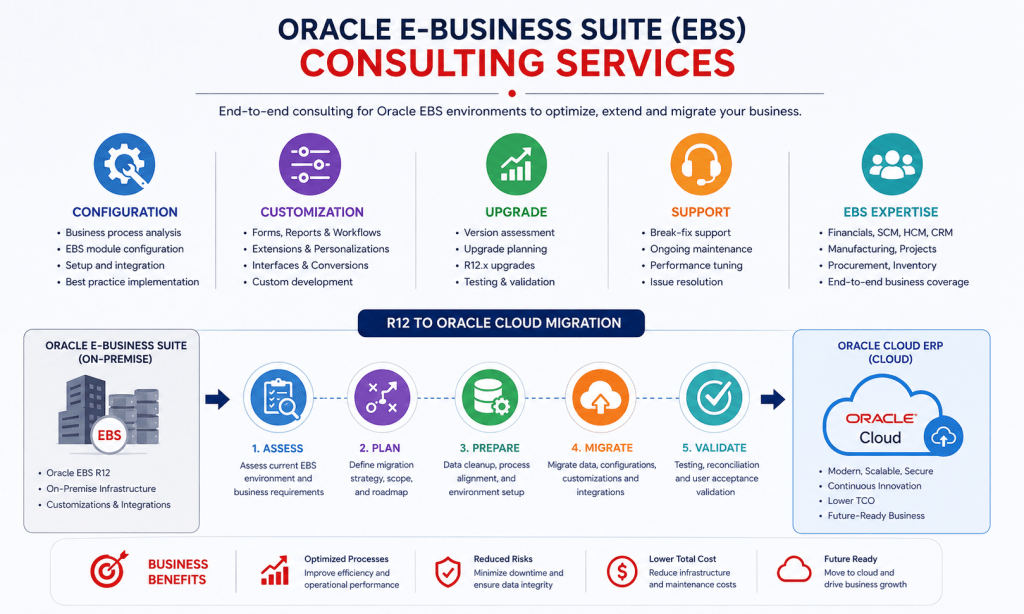
Oracle E-Business Suite (EBS) Consulting Configuration, customization, upgrade and support for Oracle EBS environments, including R12 to Oracle Cloud migration planning for organizations ready to move off on-premise.
Data Migration
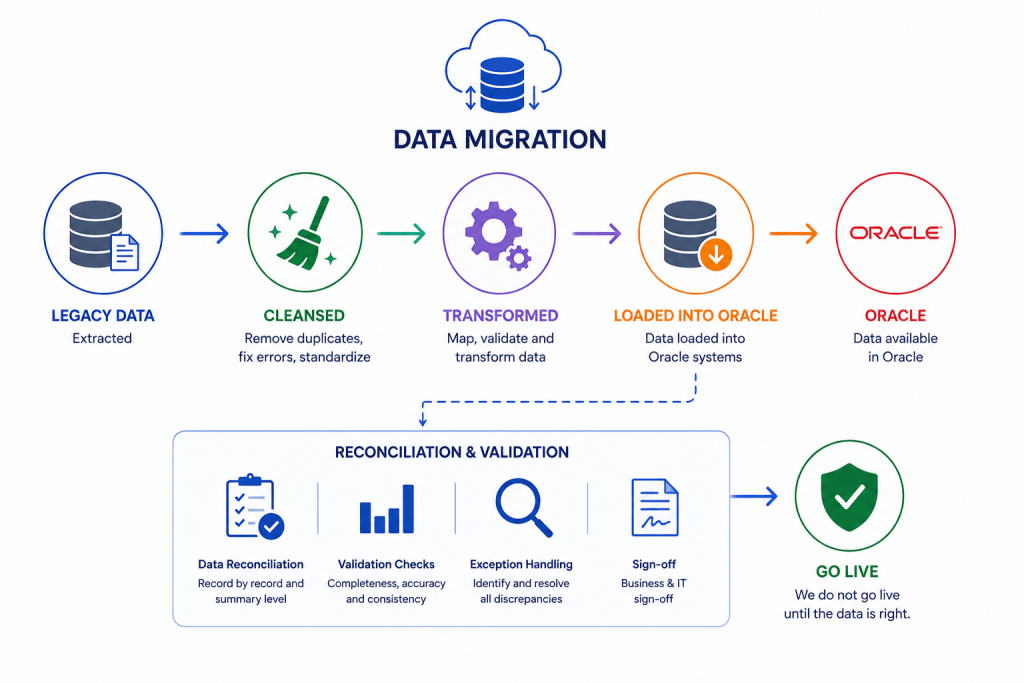
Data Migration Legacy data extracted, cleaned, transformed and loaded into Oracle with full reconciliation and sign-off. We do not go live until the data is right.
Integrations and Extensions Oracle
Integrations and Extensions Oracle integrated with your CRM, eCommerce, payroll, logistics and custom internal systems. Custom extensions built where Oracle’s standard functionality does not cover your specific workflow.

ORACLE MODULES AND PRODUCTS
Oracle Cloud ERP
Oracle On-Premise
Oracle Platform
HOW WE IMPLEMENT
Discovery & Blueprint
Business process review, gap analysis, module selection, and a detailed implementation blueprint agreed before any configuration begins. This is the step most projects rush and then pay for later.
Configure & Build
System configuration, workflow setup, report building, integration development, and custom extensions delivered in iterative cycles with regular business sign-off.
Data Migration & Testing
Legacy data migrated, reconciled, and validated. Complete unit, integration, and UAT testing performed with business users not just the technical team.
Go-Live & Hypercare
Cutover execution, go-live support, issue resolution, and a structured hypercare period so your teams are fully supported during the critical first weeks after launch.
Everything you need to know
Oracle implementations typically fail not because the system doesn't work, but because it goes live without matching how the business actually operates, creating a platform that requires workarounds and undermines the investment. This usually traces back to configuration happening before a proper business process analysis, which means the system reflects generic defaults rather than the organization's real workflows.
A full Oracle implementation covers discovery and blueprinting (business process review, gap analysis, module selection), system configuration and integration development, data migration with reconciliation and testing, and a structured go-live period with hypercare support. Licensing decisions and module selection happen early, in the discovery phase, since they directly shape what gets configured afterward.
Oracle Cloud ERP is Oracle's cloud-native ERP platform, covering modules like Financials, Procurement, Supply Chain, Project Management, and HCM delivered as SaaS. Oracle E-Business Suite (EBS) is Oracle's on-premise ERP suite, still widely used by organizations that haven't migrated to the cloud platform. Many organizations are moving from EBS to Oracle Cloud ERP over time, though the right timing depends on existing customizations and business complexity.
Legacy data migration into Oracle involves extracting data from the old system, reconciling it against source records, and validating it through unit, integration, and user acceptance testing before go-live. Testing is done with actual business users, not just the technical team, since data that looks correct in a technical validation can still fail to match how finance or operations teams expect it to behave in practice.
Hypercare is a structured support period immediately following go-live, focused on issue resolution and cutover stabilization while teams adjust to the new system. It exists because the first few weeks after an Oracle go-live are when configuration gaps, edge cases, and user adoption issues actually surface, and having dedicated support during that window prevents small issues from becoming reasons the system falls out of use.
Oracle can be configured and extended to match specific business processes rather than forcing the business to adapt to generic module defaults, through configuration, workflow setup, and custom extensions built during the implementation. This requires a proper business process review upfront so customization targets real gaps between Oracle's standard functionality and how the business actually operates, rather than being added reactively after go-live.
Where these capabilities apply