

Blog
Why AI and
Machine Learning Are the Future of Technology
According to McKinsey, more than 55%
of companies worldwide already use AI in
According to McKinsey, more than 55% of companies worldwide already use AI in at least one business function. That statistic alone is enough to pause and pay attention. Something fundamental is changing in how work gets done.
Every day, businesses handle growing volumes of data, tighter timelines, and higher expectations. Yet decisions still rely heavily on manual effort, intuition, or delayed reports. This gap between what businesses need and what traditional systems can deliver creates pressure that quietly builds over time.
This is where AI and Machine Learning begin to spark real interest. These technologies learn from data, adapt to patterns, and support faster, more informed decisions. When applied thoughtfully, they turn complexity into clarity and help organizations move forward with greater confidence and control.
What Are Artificial Intelligence and Machine Learning?
Artificial Intelligence, often called AI, refers to systems built to perform tasks that typically require human thinking. This includes understanding language, recognising patterns, and making decisions based on information. When a chatbot responds to a query or software detects unusual activity, AI is already doing the work behind the scenes.
Machine Learning (ML) is a core part of AI. Instead of following fixed instructions, these systems learn from data and improve with time. They identify patterns from past information and use those insights to make better decisions going forward.
AI and Machine Learning work best together. AI defines the objective, while machine learning continuously refines how that objective is achieved. Since nearly 90 percent of global data has been created in the last two years, the ability to learn and adjust in real time has become critical for businesses.
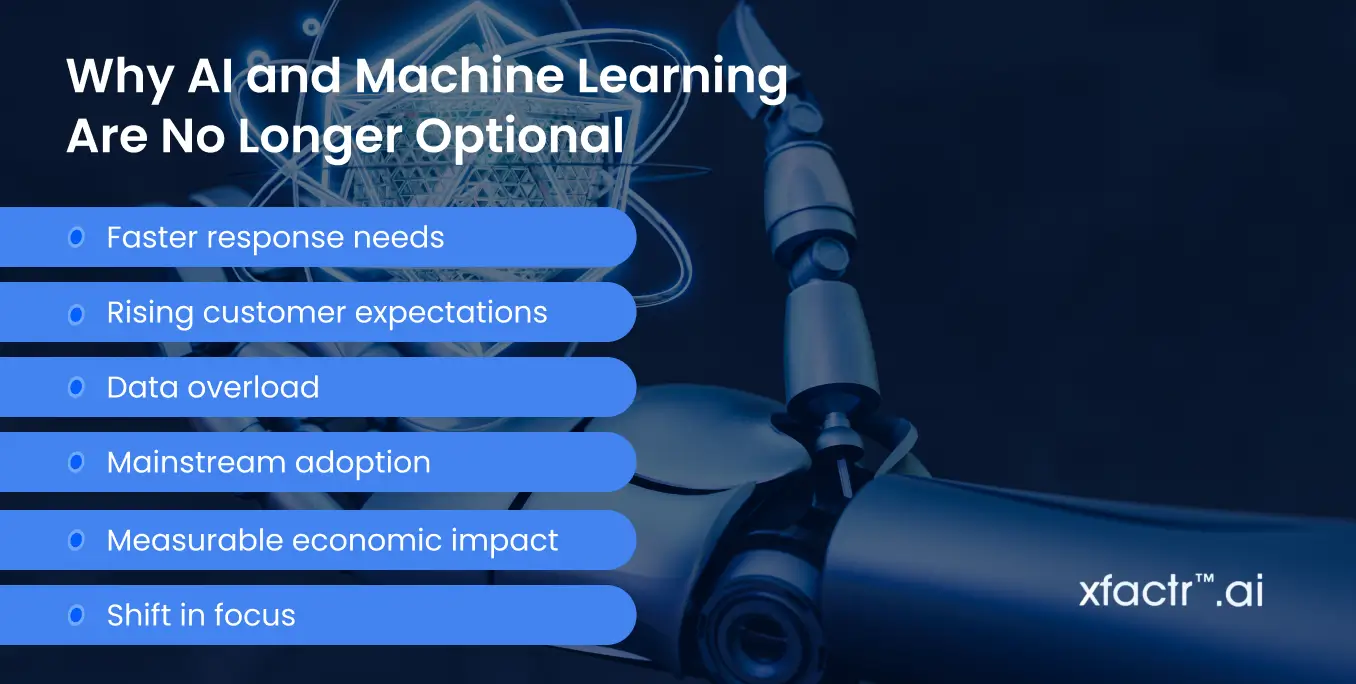
Why AI and Machine Learning Are No Longer Optional
Technology is no longer just supporting business; it now drives speed, decisions, and growth. Companies that ignore AI and Machine Learning risk falling behind, because these tools are no longer optional but essential for staying competitive.
Here’s why AI and Machine Learning are now critical:
1. Faster response needs
Markets and customer behaviour change constantly, and AI lets you react in real time instead of relying on slow manual processes.
2. Rising customer expectations
Customers expect instant, personalised, and seamless experiences. Meeting these demands at scale is almost impossible without systems that adapt automatically.
3. Data overload
4. Mainstream adoption
McKinsey reports that more than half of organisations already use AI in at least one function, proving it is no longer experimental, it is becoming standard practice.
5. Measurable economic impact
PwC estimates AI could add $15.7 trillion to the global economy by 2030, mainly through improved productivity and smarter decision-making.
6. Shift in focus
The real question is not whether to use AI, but how to implement it in a way that fits your business and growth plans.
Now that it is clear why AI and ML are essential, let us look at how they are already transforming businesses today.
How AI and Machine Learning Are Already Transforming Industries
Here’s a look at how different sectors are using these technologies right now:
Retail
About 61% of retail companies use AI to personalise experiences, plan inventory, and set dynamic pricing. This helps them understand customers better, improve sales, and keep stock levels just right.
Finance
Around 63% of financial institutions use AI for fraud detection, and 77% apply it for risk management and customer analytics. This allows banks to spot problems faster and offer more personalised services.
Manufacturing
Many manufacturers are using AI for predictive maintenance and quality control, with adoption rates around 77% in some markets. Machines are now monitored in real time, reducing unplanned downtime and keeping production on track.
Logistics
About 69% of logistics companies use AI to optimise routes, forecast demand, and manage warehouses. This means deliveries are faster, operations are smoother, and costs are lower.
Telecommunications
Around 78% of telecom firms use AI to automate customer service and monitor networks. This helps fix issues quickly and ensures customers get help when they need it.
Energy and Utilities
Roughly 47% of energy companies use AI for demand forecasting and smart grid management. This improves efficiency, prevents downtime, and supports smarter energy use.
The Real Business Benefits of AI and Machine Learning
Faster, smarter decisions
AI analyses data in real time, helping teams make accurate choices quickly instead of waiting on manual reports.
Higher productivity
Repetitive tasks are handled by AI, freeing employees to focus on work that drives impact. Accenture reports organisations using AI effectively are twice as likely to improve productivity and profitability.
Better use of data
Previously unused data now guides strategies and forecasts, turning information into actionable insights.
Scalable growth
Empowered teams
Why Strategy Matters More Than the Technology
Implementing AI is exciting, but technology alone won’t deliver results. Many projects fail not because the tools don’t work, but because the strategy isn’t clear. Gartner reports that nearly 80% of AI initiatives fail due to poor planning and integration.
Focus on what matters
Start by identifying your real business challenges, not chasing trends or flashy features.
Make it fit
AI works best when it integrates smoothly with your current systems.
Plan to scale
Knowing what to implement first and how to grow it over time makes the journey easier.
With the right guidance from experts like XFactr.AI, you can create a clear strategy, implement AI confidently, and achieve meaningful business impact.
What the Future of AI and Machine Learning Looks Like
AI as infrastructure
According to IDC, over 70% of enterprises are expected to embed AI into core processes by 2026, making it a fundamental part of operations rather than a novelty.
Smarter adoption
Risks of delay
The future is clear: AI and Machine Learning will become essential business infrastructure, not optional tools, and early adoption will define a business’s success.
To sum it up
AI and Machine Learning are changing how businesses think, decide, and grow. Not through sudden disruption, but through steady improvement. From operations and customer experience to leadership decisions, intelligent systems are becoming part of everyday work. When used with clarity and purpose, they help businesses move forward with confidence.
If you are exploring how to adopt AI in a way that feels practical and aligned with your goals, working with the right partner matters. At XFactr.AI, we help businesses integrate AI thoughtfully, without unnecessary complexity. Reach out, today!
FAQs
1. How quickly can AI be integrated into existing business processes?
Integration depends on your current systems and data readiness. With the right strategy, many businesses start seeing AI-driven insights within weeks. Working with us at XFactr.AI, ensures smooth planning and implementation for faster, reliable results.
2. Will implementing AI require large teams or big investments?
Not necessarily. AI scales with your business, solving high-impact problems first without adding excessive complexity or headcount, allowing teams to work smarter and achieve measurable returns.
3. How do businesses ensure AI decisions remain accurate and unbiased?
You can rely on AI when your data is clean and well-organised, and when the system is regularly monitored. Using transparent algorithms and providing ongoing feedback helps you keep decisions accurate and aligned with your business goals.