

Blog
The Role of
IoT and AI in Modern Business Automation
Businesses today face mounting pressure to
operate faster, smarter, and more efficiently. Yet,
Businesses today face mounting pressure to operate faster, smarter, and more efficiently. Yet, many companies still rely on manual processes that slow them down and leave room for costly errors.
The promise of artificial intelligence and IoT is the solution to it. These technologies together can automate routine tasks, provide real-time insights, and help businesses make proactive decisions rather than reactive ones. In fact, by 2025, nearly 68% of IoT data is expected to be processed using AI or machine learning technologies, underlining how critical this integration is.
So, what exactly does it mean for a company considering automation? And how can adopting these technologies transform operations? In this blog, we’ll explore everything from the basics of AI and IoT, their applications, benefits, challenges, and what the future holds for businesses ready to embrace them.
What is AI and IoT?
- Learning patterns
- Recognizing anomalies
- Making predictions
Internet of Things (IoT), on the other hand, connects devices, sensors, and machines to the internet, enabling them to collect and share data.
When AI and IoT work together, the combination becomes much more powerful:
- IoT provides the raw data
- AI processes and interprets this data, turning it into actionable insights

Why is AI Required for IoT?
IoT devices generate enormous volumes of data every second. Without AI, this data either sits idle or requires manual analysis, which is both impractical and error-prone.
AI adds intelligence to IoT, enabling:
- Real-time analysis of data
- Predictive capabilities to anticipate issues
- Autonomous responses without human intervention
Example: A network of sensors in a manufacturing plant can monitor equipment health. AI can predict failures before they occur and trigger preventive actions, reducing downtime and maintenance costs.
In essence, AI transforms raw IoT data into actionable intelligence, making automated systems smarter, faster, and more reliable. Whenever businesses plan automation, it’s the combination of AI and IoT that drives true operational efficiency.
Next, we’ll explore how this synergy is applied in everyday business functions.
How Artificial Intelligence and IoT Enable Business Automation
- IoT devices capture real-time information such as temperature, machine usage, or product inventory.
- AI analyzes this data, detects patterns, and predicts future outcomes.
- Equipment anomalies
- Supply chain disruptions
- Service delays
This ensures issues are addressed before they grow into bigger problems.
By combining AI and IoT, businesses build systems that are responsive, adaptive, and highly efficient. These systems offer a detailed view of operations and the intelligence to act on it, resulting in faster decisions and better outcomes.
Next, we will look at specific applications where businesses are already experiencing these benefits.
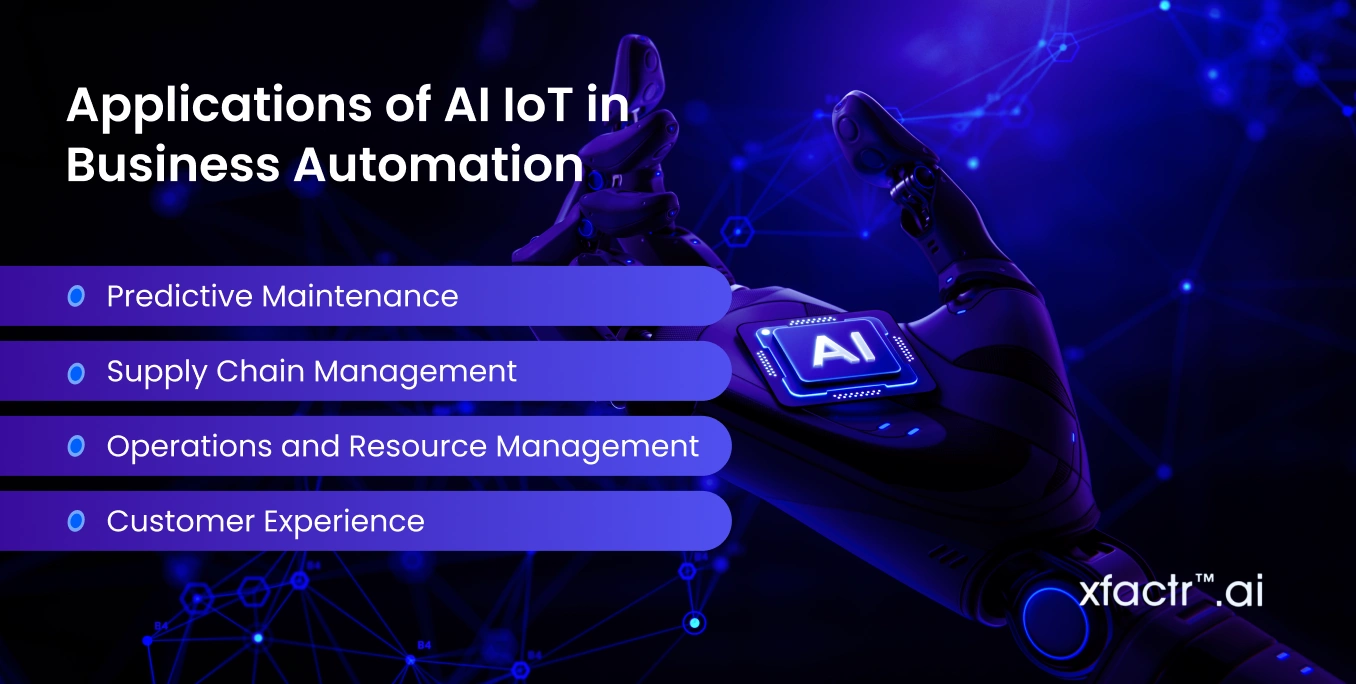
Applications of AI IoT in Business Automation
Predictive Maintenance
One of the most significant applications is in predictive maintenance. Nearly 71% of organizations use AIoT for maintenance to prevent unexpected equipment failures. Sensors collect machine data, and AI analyses it to predict potential breakdowns, saving time and costs.
Supply Chain Management
Operations and Resource Management
Customer Experience
The combination of artificial intelligence and IoT transforms processes, making them faster, more accurate, and predictive rather than reactive.
Next, let’s explore how companies are using these technologies in real-world scenarios.
Real World Examples of AI IoT
Manufacturing
Retail
Healthcare
Logistics and Transportation
Energy and Utilities
Benefits of Using Artificial Intelligence and IoT in Business Automation
Improved Efficiency
Over 90% of organizations adopting IoT report increased productivity as a top benefit. AI processes data instantly, reducing delays and streamlining operations.
Cost Savings
Better Decision-Making
Scalability and Competitive Advantage
The Future of AI IoT in Business Automation
The future of automation will be defined by smarter and more autonomous systems. Edge computing will allow devices to process data locally, reducing latency. AI will not only provide insights but also make real-time decisions without human intervention.
By 2025, AI-integrated IoT deployments are expected to cover nearly 90% of connected devices in enterprises. Businesses will increasingly rely on these systems to optimize processes, enhance customer experiences, and maintain operational resilience.
In short, artificial intelligence and IoT are no longer optional—they are critical for companies that want to remain competitive, agile, and responsive to market changes.
Key Takeaways
Automation driven by AI and IoT is transforming the way businesses operate. Companies that adopt these technologies are not just collecting data, but converting it into insights, actionable decisions, and measurable results. From predictive maintenance to smarter supply chains and better customer engagement, the impact of AIoT is undeniable.
If your company wants to streamline operations, reduce costs, and gain a competitive edge, connect with XFactr.AI™ today and let us help you unlock the full potential of AI and IoT for smarter, faster, and more effective business automation.
FAQs
1. Can small businesses benefit from AI and IoT, or is it only for large enterprises?
Absolutely. Even small businesses can use AI and IoT to monitor operations, predict issues, and optimize resources. Scalable AIoT solutions allow companies of any size to automate routine tasks, reduce costs, and improve decision-making without heavy upfront investment.
2. How quickly can a company see results after implementing AIoT?
Results vary depending on processes and system complexity, but many businesses notice efficiency gains, predictive insights, and operational improvements within a few months. Starting with high-impact areas like maintenance, inventory, or logistics usually delivers the fastest measurable outcomes.
3. Do AI and IoT require specialized technical skills to manage?
Not necessarily. Modern AIoT platforms are user-friendly, with dashboards, alerts, and automated actions. For businesses without in-house expertise, XFactr.AI™ provides end-to-end support, helping companies implement, monitor, and optimize AI and IoT systems effectively.