

Blog
MLOps vs DevOps:
Which Approach Fits Your Organization?
Technology is evolving faster than most
teams can keep up with. Businesses want
Technology is evolving faster than most teams can keep up with. Businesses want to move quickly, stay innovative, and deliver results without delays. But as software and AI systems get more complex, keeping them running smoothly is challenging.
Nearly 74% of organizations have adopted DevOps practices, while the global MLOps market is projected to grow from USD 1.1 billion in 2022 to USD 5.9 billion by 2027, at a CAGR of 41%. This highlights that companies want faster software delivery and reliable AI deployment, yet operationalizing AI remains a major challenge.
Modern organizations know that just writing good code is not enough. Teams also need automation, teamwork, and processes that use data effectively. This is where DevOps vs MLOps comes in. In this blog, we’ll explain what they are, why they matter, and how to decide which one works best for your organization.
What is DevOps? What is it used for?
- Automating software delivery: It manages the continuous integration and deployment of applications.
- Improving collaboration: It aligns developers and IT teams to work as one.
- Speeding up releases: It reduces the time between code development and deployment.
- Ensuring stability: It minimizes human errors by using automated testing and monitoring.
- Enhancing productivity: It frees teams from repetitive manual tasks through automation tools.

A typical use case might involve a team building and releasing a web application. With DevOps, instead of working in silos, developers and IT teams share one continuous workflow. This ensures that new updates reach customers quickly and efficiently.
The purpose of DevOps is not just speed; it’s also about reliability and consistency. When your systems can handle frequent updates without breaking, your customers stay happier and your team stays productive.
In short, DevOps focuses on improving how software moves from idea to release. And that’s something every tech-driven business needs today.
Why is DevOps important to a company?
DevOps plays a vital role in making businesses more agile and efficient. It eliminates the old model of “throwing code over the wall” between developers and operations teams. Instead, it creates a shared responsibility for the entire product lifecycle.
Here are a few reasons why DevOps is important to a company:
- Faster time-to-market: Automating builds and tests helps teams deliver updates quickly.
- Fewer failures: Continuous monitoring and integration reduce bugs and downtime.
- Improved collaboration: Developers and operations teams work together instead of working in silos.
- Cost savings: Automation and early error detection save company’s resources and manpower.
- Customer satisfaction: Frequent, stable updates help improve user experience.
When companies adopt DevOps, they often see better productivity and faster innovation. Now, as businesses move beyond software and into artificial intelligence, another practice is becoming just as essential: MLOps.
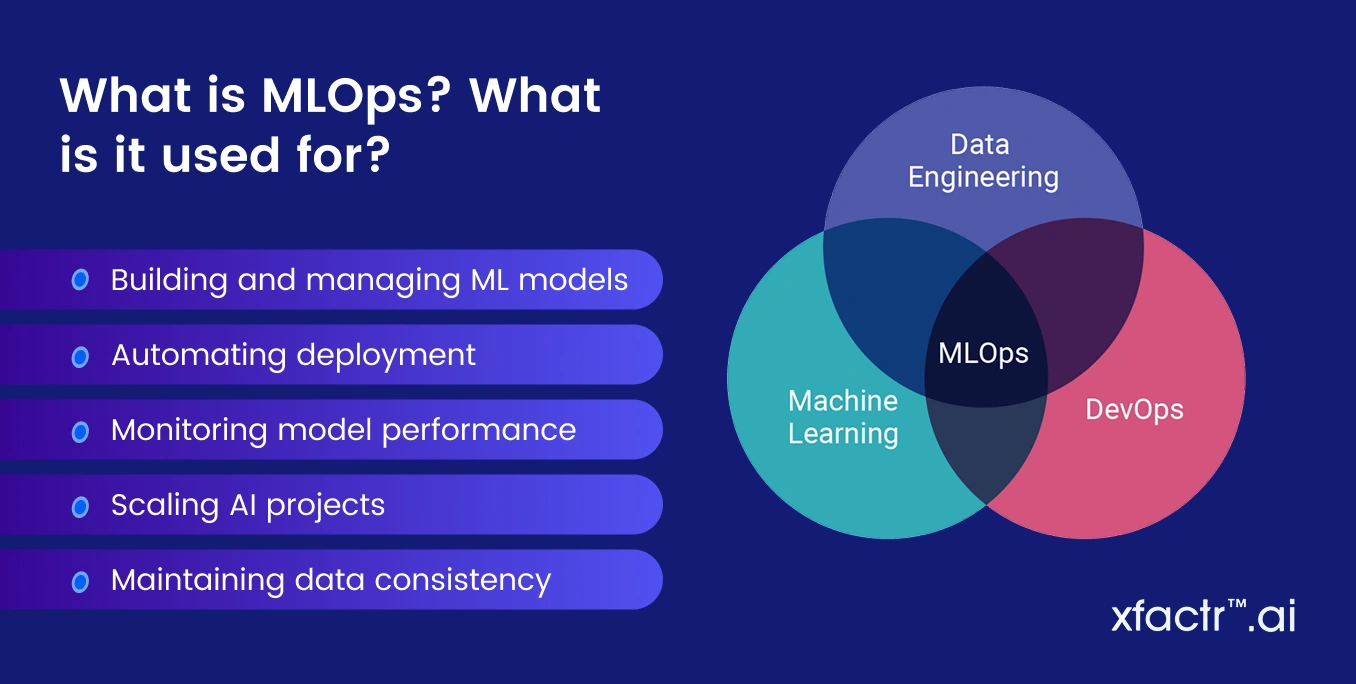
What is MLOps? What is it used for?
MLOps stands for Machine Learning Operations. It extends the DevOps philosophy to the world of machine learning and artificial intelligence. While DevOps focuses on code, MLOps manages both code and data.
Here’s what MLOps is used for:
- Building and managing ML models: It helps create and test machine learning models efficiently.
- Automating deployment: It allows models to move smoothly from experimentation to production.
- Monitoring model performance: It tracks accuracy, data drift, and real-world effectiveness.
- Scaling AI projects: It helps organizations manage multiple models and datasets at once.
- Maintaining data consistency: It ensures data quality and reproducibility across the ML lifecycle.
For example, imagine a company building a recommendation engine. Data scientists experiment with models using large datasets. Once a model works well in testing, MLOps tools help deploy it into production while monitoring its accuracy over time.
MLOps brings structure and reliability to AI projects, ensuring that models don’t just work in labs but also perform well in real-world scenarios.
In simple words, if DevOps helps you release apps faster, MLOps helps you scale your AI confidently.
Why is MLOps important to a company?
Without MLOps, machine learning projects often get stuck in experimentation. In fact, according to Gartner, around 85% of AI models never make it to production. That’s because managing data, retraining models, and maintaining accuracy over time is complicated.
Here’s why MLOps is important to a company:
- Scalability: It lets businesses handle multiple models and datasets efficiently.
- Consistency: Ensures models are reproducible and version-controlled.
- Reduced model drift: Automatically tracks and updates models when performance drops.
- Cross-team collaboration: Bridges data scientists, ML engineers, and operations teams.
- Faster deployment: Turns AI research into real business results quickly.
In a world where data changes every day, MLOps keeps AI systems stable and aligned with current trends. It’s a must for businesses that want to make data-driven decisions at scale.
Before deciding which approach fits your organization, it’s helpful to see how they differ in structure and purpose.

DevOps vs MLOps: Key Differences Explained
| Aspect | DevOps | MLOps |
|---|---|---|
| Purpose | Streamline software development and delivery | Manage end-to-end machine learning lifecycle |
| Pipeline focus | Code integration, testing, deployment | Data processing, model training, evaluation, deployment |
| Data dependency | Low, mainly focuses on code | High, relies on large and evolving datasets |
| Toolchain | Jenkins, Docker, Kubernetes, GitHub | MLflow, TensorFlow Extended, Kubeflow |
| Team roles | Developers, IT operations | Data scientists, ML engineers, DevOps teams |
| Monitoring metrics | System uptime, error rate | Model accuracy, data drift, prediction quality |
While DevOps focuses on code, MLOps focuses on both code and data. Each approach has its unique strengths, and most modern companies find value in blending the two.
Let’s look at how to decide which one makes more sense for your business right now.
When to Choose DevOps or MLOps (or Both)
Every organization has different goals and challenges. The right approach depends on what stage your business is in and how much you rely on data or AI.
If your company builds and deploys regular software applications such as web apps, tools, or services, DevOps is a great place to start. Because it’ll help you improve collaboration, speeds up delivery, and makes releases more predictable.
However, if your organization works heavily with data, predictive analytics, or machine learning models, then MLOps is what you need. As it’ll help you manage the full lifecycle of AI models and ensures your systems stay accurate over time.
For many growing businesses, the best approach is to start with DevOps and extend to MLOps as your AI capabilities expand. This way, you build a strong technical foundation before scaling into data-driven automation.
The transition from DevOps to MLOps doesn’t happen overnight. It’s a gradual shift that depends on team maturity, tools, and business needs.

DevOps vs MLOps: Common Challenges and Best Practices
Both DevOps and MLOps come with their fair share of challenges. Implementing them successfully requires patience, the right tools, and team alignment.
Here are a few common challenges:
- Data versioning issues: Keeping track of data and models can get complex.
- Model drift: AI models may lose accuracy as data patterns change.
- Cross-functional coordination: Teams often struggle to align goals and processes.
- Tool overload: Too many tools can slow down adoption.
- Automate pipelines wherever possible.
- Model drift: AIStandardize workflows for reproducibility. models may lose accuracy as data patterns change.
- Continuously monitor systems and models for performance drops.
- Invest in skill development for both DevOps and MLOps teams.
Final Thoughts
Both DevOps and MLOps represent a shift toward smarter, faster, and more reliable operations. DevOps brings efficiency and speed to software development, while MLOps ensures that data-driven models perform well over time. Together, they help organizations build systems that are not just functional but intelligent, adaptable, and future-ready.
Choosing the right approach can make the difference between running a reactive IT setup and leading innovation. If your organization is ready to unlock the power of AI and bring automation into your workflows, XFactr.AI™can help you fast-track the process. With the right strategy and tools, you can build systems that think, learn, and grow with your business.