
How to Move AI From POC to Production: The Enterprise AI Implementation Guide
A practical enterprise AI implementation guide covering architecture, model serving, MLOps, observability, governance, integration and the path from AI proof of concept to production.
Key takeaways
- Most AI proofs of concept are optimized for learning, not operating.
- A practical stack separates ingestion, feature or retrieval preparation, model inference, orchestration, application APIs and business systems.
- Production AI needs measurable controls: data quality checks before inference, model performance monitoring, drift detection, structured logging, trace IDs, latency budgets and automated rollback.
- An AI application rarely lives alone.
Why POCs stall after the demo
Most AI proofs of concept are optimized for learning, not operating. A notebook can prove that a model works on a curated dataset. Production has to handle identity, data contracts, latency, model versioning, rollback, cost controls, observability and failure modes. That is the gap between an AI POC to production exercise and a production system.
A production architecture
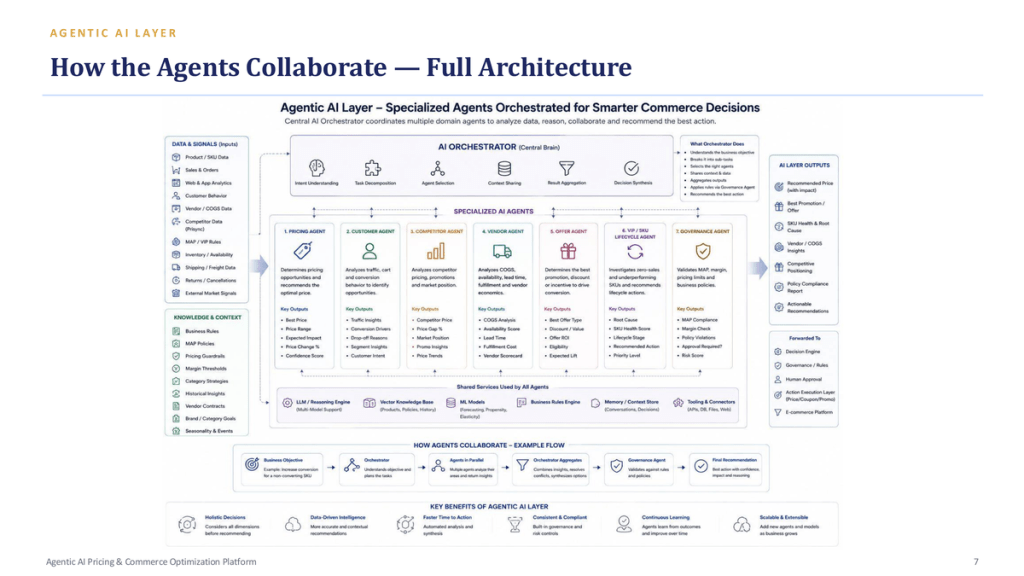
A practical stack separates ingestion, feature or retrieval preparation, model inference, orchestration, application APIs and business systems. Containerized services can run on Kubernetes or managed cloud compute, while CI/CD promotes code and model artifacts through dev, staging and production. A model registry should track version, training data, evaluation metrics and deployment status.
MLOps controls that matter
Production AI needs measurable controls: data quality checks before inference, model performance monitoring, drift detection, structured logging, trace IDs, latency budgets and automated rollback. For generative systems, add prompt and response evaluation, retrieval quality checks, token and cost monitoring, and policy filters. This is where MLOps and DevOps stop being separate disciplines.
Integration and governance
An AI application rarely lives alone. Enterprise AI development usually means connecting CRM, ERP, data platforms, identity providers and operational applications through APIs and event streams. Human approval thresholds should be explicit for financial, customer or operational decisions. Governance should cover access, auditability, data retention and model change control.
How the pieces fit together
For an enterprise team, the practical sequence is straightforward: define the business outcome, map the data and systems involved, design the architecture, build a controlled first release, instrument it, validate it with real users and then scale what proves useful. This keeps technology grounded in an operating process rather than turning AI into another disconnected tool.
Frequently Asked Questions
What is the main engineering challenge discussed here?
Most AI proofs of concept are optimized for learning, not operating.
What should an enterprise architecture include?
A production design should account for data, application services, integration, security, observability, governance and clear operational ownership.
How can a team move from an idea to production?
Start with the business outcome, validate the data and integration path, build a controlled release, measure it with real users and scale only after the operating controls are in place.
Building something that has to work in production?
Talk with XFactr.ai about the architecture, data, AI and engineering work behind your next enterprise system.
Talk to an Expert