
Enterprise Agentic AI: How AI Agents Automate Business Workflows
How enterprise AI agents use tools, orchestration, APIs, policies and human approval to automate real business workflows without turning automation into a black box.
Key takeaways
- An AI agent is useful when it can observe a business state, choose a permitted action, use a tool and verify the result.
- A typical AI workflow automation loop is: receive an event, retrieve context, plan the next step, call a tool, validate the response, update the system of record and request approval when required.
- Production AI agent development services need JSON-schema tool contracts, idempotency keys, retries, timeouts, circuit breakers and traceable execution logs.
- AI business automation is particularly useful for document intake, case triage, procurement, finance operations, customer support and internal knowledge workflows.
Agents need boundaries
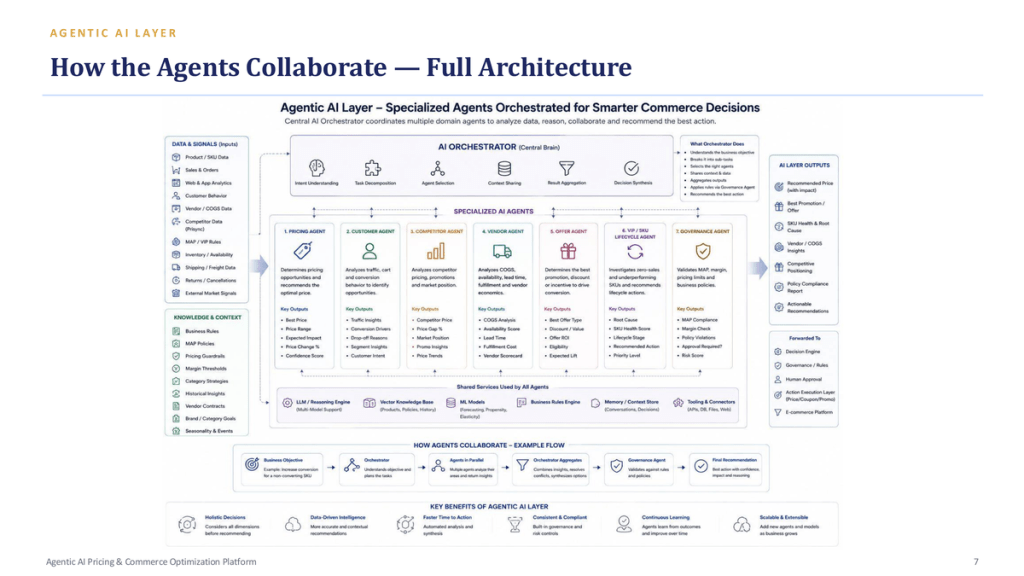
An AI agent is useful when it can observe a business state, choose a permitted action, use a tool and verify the result. The safest enterprise AI agents are not given unlimited access. Each tool has a defined schema, permission scope, timeout and expected output.
From workflow to agent loop
A typical AI workflow automation loop is: receive an event, retrieve context, plan the next step, call a tool, validate the response, update the system of record and request approval when required. Deterministic rules should handle hard constraints while the agent handles tasks that benefit from reasoning or language.
Technical controls
Production AI agent development services need JSON-schema tool contracts, idempotency keys, retries, timeouts, circuit breakers and traceable execution logs. Confidence thresholds can route uncertain actions to people. Sensitive operations should use explicit approval gates rather than autonomous execution.
Where agentic automation fits
AI business automation is particularly useful for document intake, case triage, procurement, finance operations, customer support and internal knowledge workflows. The right design starts with the process map, not the model. This keeps enterprise AI automation measurable and easier to govern.
How the pieces fit together
For an enterprise team, the practical sequence is straightforward: define the business outcome, map the data and systems involved, design the architecture, build a controlled first release, instrument it, validate it with real users and then scale what proves useful. This keeps technology grounded in an operating process rather than turning AI into another disconnected tool.
Frequently Asked Questions
What is the main engineering challenge discussed here?
An AI agent is useful when it can observe a business state, choose a permitted action, use a tool and verify the result.
What should an enterprise architecture include?
A production design should account for data, application services, integration, security, observability, governance and clear operational ownership.
How can a team move from an idea to production?
Start with the business outcome, validate the data and integration path, build a controlled release, measure it with real users and scale only after the operating controls are in place.
Building something that has to work in production?
Talk with XFactr.ai about the architecture, data, AI and engineering work behind your next enterprise system.
Talk to an Expert