
Dynamic Pricing for E-Commerce: A Practical Guide to Price Elasticity, AI-Powered Pricing & Margin-Safe Growth
Most retailers either leave pricing on autopilot or chase the competitor's lowest number. Neither works once you actually understand what price elasticity is telling you.
Key takeaways
- Dynamic pricing works best when it is informed by SKU-level price elasticity of demand, rather than relying only on a single store-wide rule.
- Many "AI pricing" tools are primarily single-model or rule-based repricers. A more reliable pattern uses several specialized agents and analytical services that independently evaluate the recommendation before an orchestrator synthesizes the result for human approval.
- For vendor-fulfilled or drop-ship retailers, cost of goods, MAP agreements, and fulfillment lead time matter as much as demand - pricing logic has to account for all three at once.
- Zero-sales products usually aren't a pricing problem in isolation - they're a root-cause problem across price, traffic, shipping cost, and fulfillment.
- Shipping and handling cost can act as an important demand-response lever. Total landed cost, not sticker price, is what customers actually react to.
- The logic behind elasticity-based pricing isn't unique to retail - it shows up in travel, subscriptions, quick commerce, energy, and ticketing too.
◆ ◆ ◆
There’s a particular kind of pricing meeting that happens at almost every mid-size retailer. Someone pulls up a spreadsheet, points at a SKU that hasn’t sold in ninety days, and asks, “should we drop the price?” Somebody else says a competitor is $8 cheaper. A third person worries out loud about margin. Twenty minutes later, the price gets cut by a round number nobody can really defend, and the team moves on to the next item on the list.
That meeting is the reason most dynamic pricing initiatives underperform. Not because the team lacks data – most retailers today are drowning in it – but because nobody in the room actually knows how sensitive that specific product’s demand is to price. They’re guessing. And guessing at scale, across thousands of SKUs, is expensive.
This is a long piece, so let’s be upfront about what it covers: what dynamic pricing actually means beyond the marketing definition, why price elasticity of demand is the concept that separates pricing that works from pricing that just moves numbers around, and how a more disciplined, AI-powered approach handles pricing, promotions, and even shipping costs together instead of as three disconnected problems.
◆ ◆ ◆
What Dynamic Pricing Actually Means (and What It Doesn't)
Dynamic pricing is the practice of adjusting prices in response to changing conditions – demand, competitor moves, inventory position, cost of goods, or time – rather than setting a price once a year and leaving it alone. That’s the textbook version, and it’s accurate as far as it goes.
In practice, most people conflate dynamic pricing with one narrow subset of it: surge pricing, the kind that spikes ride-hailing fares during a storm. That’s dynamic pricing, technically, but it’s the least useful version of the idea for a typical online retailer. Nobody wants to be the brand that raises prices the moment demand ticks up, it reads as opportunistic, and in categories like healthcare or home goods it can genuinely damage trust.
The version of dynamic pricing that actually moves the needle for e-commerce businesses is quieter and more continuous. It’s a system that constantly asks: is this specific product priced at the point where we maximize revenue or margin, given what we know about how customers respond to price on this item? That question can’t be answered with a store-wide rule like “always beat the lowest competitor by 2%.” It has to be answered product by product, and that’s where price elasticity comes in.
The Main Types of Dynamic Pricing in Retail
Before going deeper into elasticity, it’s worth separating the strategies retailers actually use, because they get lumped together constantly:
- Competitor-based repricing – matching or beating a tracked competitor’s price, often the entry point for most retailers and the easiest to get wrong if used alone.
- Cost-plus with COGS updates – recalculating price whenever vendor cost changes, common for drop-ship and marketplace-fed catalogs.
- Demand and elasticity-based pricing – setting price based on how sensitive actual conversion is to price changes for that product.
- Time and seasonality-based pricing – adjusting for predictable demand cycles, like patio furniture in spring or mobility aids after flu season.
- Segment or channel-based pricing – different pricing logic for loyalty members, B2B accounts, or specific sales channels.
- Promotion and offer-based pricing – keeping the sticker price stable but using coupons, bundles, or free shipping as the lever instead, which matters enormously once minimum advertised price (MAP) agreements are in play.
Most mature pricing programs blend several of these. The mistake is picking just one, usually competitor matching, and applying it uniformly across a catalog where products behave nothing alike. That’s the gap elasticity is meant to close, and it’s a big part of what our custom AI and ML development work focuses on for retail clients.
◆ ◆ ◆
Price Elasticity of Demand: The Concept Everyone Cites and Almost Nobody Measures
Price elasticity of demand is one of those ideas that gets taught in the first month of an economics class and then, somehow, almost never gets applied properly in an actual pricing decision. The definition is simple enough: it’s a measure of how much the quantity of a product people buy changes when its price changes..
Price Elasticity of Demand = % change in quantity demanded ÷ % change in price
If you drop a product’s price by 10% and unit sales climb by 25%, the estimated price elasticity is approximately -2.5 (or 2.5 in absolute value), indicating highly elastic demand, where price is doing a lot of the work in the buying decision. If you drop the same product’s price by 10% and unit sales only rise by 2%, the estimated elasticity is approximately -0.2 (or 0.2 in absolute value), indicating relatively inelastic demand, meaning something other than price is driving the purchase: brand trust, prescription requirement, insurance reimbursement, or simply that there’s no good substitute.
Here’s the part that gets missed constantly: elasticity is not necessarily a property of a store or category as a whole. It can vary by product, price range, customer segment, channel, competitive context, and time period. A $40 commodity item and a $2,400 specialty item sold by the same retailer can have wildly different elasticity, even if they sit in the same product category.
Elastic vs. Inelastic Goods: What This Looks Like in a Real Catalog
| Signal | Elastic Demand (price-sensitive) | Inelastic Demand (price-insensitive) |
|---|---|---|
| Typical products | Commodity items, easily substituted, many sellers | Specialty or prescribed items, few substitutes, brand-specific |
| Response to a 5-10% price cut | Noticeable jump in conversion and units | Little to no measurable change |
| Competitor price gap sensitivity | High - customers compare and switch | Low - customers buy on need, not price |
| Potential pricing lever | Price and promotion together | Availability, content quality, service, trust signals |
This matters because the instinct in most pricing meetings is to treat every underperforming SKU the same way: cut the price. For an elastic product, that’s often correct. For an inelastic one, cutting price mostly just gives away margin on sales that were going to happen anyway, while doing nothing for the units that weren’t converting because of a completely different reason, more on that later, in the section on zero-sales products.
Why this matters for AI pricing specifically
Any pricing engine that recommends a price without incorporating demand response, elasticity, experimentation, or other evidence of price sensitivity risks becoming a black-box recommendation rather than an economically grounded pricing decision. The output looks confident. The math underneath may not be there. Before trusting a recommendation, it’s worth asking the system, or the vendor, what the elasticity estimate was based on, and how much sales history it needed to be reliable.
◆ ◆ ◆
Why Price Elasticity Is the Real Engine Behind Dynamic Pricing
It’s worth pausing here, because this is the part that gets skipped in most pricing conversations. Elasticity isn’t a nice-to-have data point you glance at once a quarter. It’s the input that determines whether every other pricing decision helps or hurts you. Here’s why it carries that much weight.
It protects margin instead of just chasing volume
A retailer that discounts everything equally is optimizing for the wrong thing. Cutting price on an inelastic product doesn’t generate meaningfully more demand, it just lowers the price on sales that were going to happen anyway. Elasticity tells you where a discount actually buys you volume, and where it just buys you a smaller invoice.
It’s what makes competitive pricing sustainable
Matching competitors on every SKU is how retailers end up in a race to the bottom that nobody wins. Elasticity lets you be selectively aggressive: match or beat price on the handful of high-traffic, high-elasticity items customers actually comparison-shop, and hold firm on specialty or low-elasticity items where price was never the deciding factor.
It shapes the promotional calendar, not just individual prices
Marketing teams plan sales events, coupon campaigns, and seasonal promotions months in advance. Knowing which categories respond to price and which respond to urgency, bundling, or free shipping changes what that calendar should actually contain, rather than running the same blanket 15%-off event across a catalog with wildly different price sensitivity.
It keeps automation from becoming a liability
Once pricing decisions start getting automated, an elasticity estimate is what separates a defensible recommendation from a black-box guess. A system that can say “this SKU has an elasticity of roughly 1.8, so a 5% cut should lift units by about 9%” gives a human reviewer something concrete to evaluate. A system that just outputs a price gives them nothing to push back on.
It applies well beyond a single product page
Elasticity isn’t only about the sticker price. It shows up in how customers respond to shipping costs, minimum order thresholds, loyalty pricing, and even how a price is displayed on the page. Anywhere money changes hands based on a decision a customer makes, some version of elasticity is quietly at work.
The mistake isn’t cutting the price. It’s cutting the price without knowing whether this particular product would have sold anyway.
◆ ◆ ◆
How Elasticity Actually Gets Measured in Practice
Very few retailers have the luxury of running clean, controlled price experiments across their entire catalog, that takes time, traffic, and patience most teams don’t have. So in practice, elasticity gets estimated from a mix of signals rather than derived from a single formula:
- Historical price change data – every past price change is a mini experiment. What happened to conversion and units the last three, four, five times this SKU’s price moved?
- Competitor price gap over time – tracking how conversion shifts as the gap between your price and the market average widens or narrows.
- Funnel behavior – traffic, add-to-cart rate, and cart abandonment, which often reveal price sensitivity before a single sale is lost. A high add-to-cart rate with a low completion rate is frequently a price or total-cost signal.
- Category-level elasticity as a prior – for new or low-traffic SKUs without enough history, borrowing an elasticity estimate from similar products in the same category and price band, then refining it as real data comes in.
- Seasonality-adjusted comparisons – separating “sales dropped because of a price increase” from “sales dropped because it’s the off-season,” which sounds obvious and is very easy to get backwards under deadline pressure.
- Controlled price experiments and A/B tests – where traffic and operational conditions allow, controlled price variation provides stronger evidence of causal price sensitivity than relying only on historical correlations. The experiment should account for sample size, statistical significance, seasonality, competitor movement, and margin impact.
None of this necessarily requires exotic mathematics. It requires disciplined data collection, appropriate statistical modeling, experimentation where feasible, and consistent measurement, resisting the urge to explain away a bad pricing decision after the fact instead of using the outcome to improve the next one. This is where a lot of “AI pricing” marketing overpromises: the algorithm isn’t the hard part. Getting clean, structured historical pricing and conversion data in one place, per SKU, is a data engineering problem well before it’s a modeling problem.
From Correlation to Causal Pricing: Why Experiments Matter
Historical data can tell a retailer that price and conversion moved together, but it does not always prove that the price change caused the conversion change. Pricing decisions are often made in response to demand, promotions, inventory, competitor activity, seasonality, or other factors that are changing at the same time.
For that reason, a mature pricing system should combine historical modeling with controlled experimentation where practical. A/B price tests, geo-based experiments, or carefully designed holdout groups can provide stronger evidence of how customers respond to different price points, which is as much a data and analytics discipline as it is a pricing one.
A useful experimentation framework should measure not only conversion, but also revenue, gross profit, average order value, cart abandonment, customer behavior, and competitor response. The system should also enforce guardrails around minimum margin, MAP requirements, price-change limits, and customer fairness, guardrails that belong to the same analytics and governance layer that protects the rest of a pricing program.
The resulting feedback loop becomes:
- Observe
- →
- Estimate
- →
- Simulate
- →
- Experiment
- →
- Measure
- →
- Learn
- →
- Update
Running that loop continuously, in production, without someone babysitting it by hand, is fundamentally an MLOps problem: models need to be retrained, experiments need to be tracked, and results need to feed back into the next estimate automatically. This is particularly important for low-data SKUs. Rather than pretending that an elasticity estimate is highly accurate, the system can assign a confidence level, borrow information from similar products where appropriate, using the kind of shared data platform that lets one SKU’s history inform another’s, and use controlled experiments to improve the estimate over time.
◆ ◆ ◆
Why Most “Dynamic Pricing” Tools Quietly Fail Retailers
A lot of repricing software on the market solves a narrower problem than retailers think they’re buying. Broadly, they fall into two camps.
The first camp is pure competitor-matching engines: track a handful of competitors, set a rule (“beat by $1” or “match the lowest”), and update the price automatically. This works fine in commoditized categories with thin differentiation. It becomes actively harmful in categories with MAP agreements, specialty products, or vendor-fulfilled inventory, because the tool has no concept of your actual cost, your fulfillment economics, or whether undercutting is even allowed on that SKU.
The second camp includes single-model machine learning repricers, systems that may be trained to predict demand, conversion, or an optimal price as a single recommendation. These are a step up, but they tend to be a black box: the business team gets a price and has to trust it, with limited ability to ask why, or to separately investigate whether the real problem was actually availability, shipping cost, or content quality rather than price at all.
Neither approach reflects how an experienced pricing analyst actually thinks. A good analyst doesn’t just ask “what price maximizes conversion.” They ask a sequence of questions: Where do we stand versus the market? What’s our actual margin at this price given current vendor cost? Is this SKU even allowed to be discounted under our MAP agreement? Would a promotion work better than a price cut? What’s the confidence level here, and is this a decision I’m comfortable automating or one that needs a second set of eyes? That’s a genuinely different kind of system to build than a single price-prediction model, and it’s the approach we’ve moved toward in our own
AI and ML development
work, informed by the same
AI consulting and strategy
thinking we bring to any enterprise decision system.
A More Reliable Pattern: Specialized AI Agents Instead of One Black-Box Model
The approach we keep coming back to when we build pricing systems for retail clients is what’s now commonly called an agentic AI pattern, one of the core patterns behind our own
agentic AI solutions
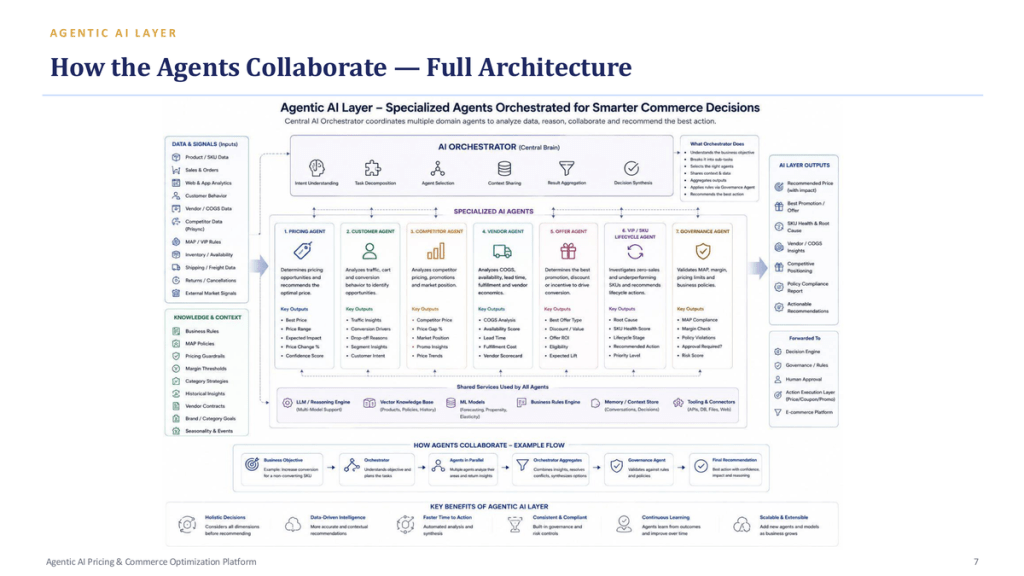
work. Instead of one model trying to reason about pricing, competition, vendor economics, and policy compliance all at once, the work is split across specialized agents that each own a narrow domain, coordinated by a central orchestrator. It’s closer to how a real pricing committee operates than how a typical repricer works.
In a typical setup, you’d see agents responsible for:
- Pricing – estimating elasticity, simulating multiple price points, and recommending the optimal price with a confidence score.
- Competitor intelligence – tracking market position, price gaps, and promotional activity across tracked sellers.
- Vendor economics – analyzing current cost of goods, availability, and fulfillment lead time, which matters enormously for retailers who don’t hold their own inventory.
- Customer behavior – reading traffic, cart, and conversion signals to separate a pricing problem from a discovery or content problem.
- Offers and promotions – deciding whether a coupon, bundle, or free-shipping offer would outperform a straight price change, especially on MAP-protected products where the sticker price legally can’t move.
- Governance – checking every recommendation against margin floors, MAP rules, and business policy before it’s ever shown to a human reviewer.
An orchestrator sits above these components, decomposes the business question, routes tasks to the appropriate analytical agents or services, runs independent analyses where appropriate, and synthesizes their outputs into one governed recommendation, with the reasoning attached, not just the number. Much of that reasoning layer leans on the same
generative AI
techniques used to turn a model’s raw output into an explanation a merchandising team can actually read. That last part is what tends to earn trust from pricing and merchandising teams who’ve been burned before by a black-box tool. When a recommendation says “reduce price by 4%, expected conversion lift of 15-20%, based on a competitive gap and elevated cart abandonment,” a human reviewer can actually evaluate that logic instead of taking it on faith.
The Real differentiator
A well-designed agentic pricing system doesn’t just ask “what price should we set?” It asks why a product isn’t converting, what the best commercial lever is, price, promotion, content, or vendor change, what the expected business impact is, and whether the decision is safe to automate or needs a human to sign off. That framing changes the kind of tool you end up building.
◆ ◆ ◆
What This Looks Like Step by Step
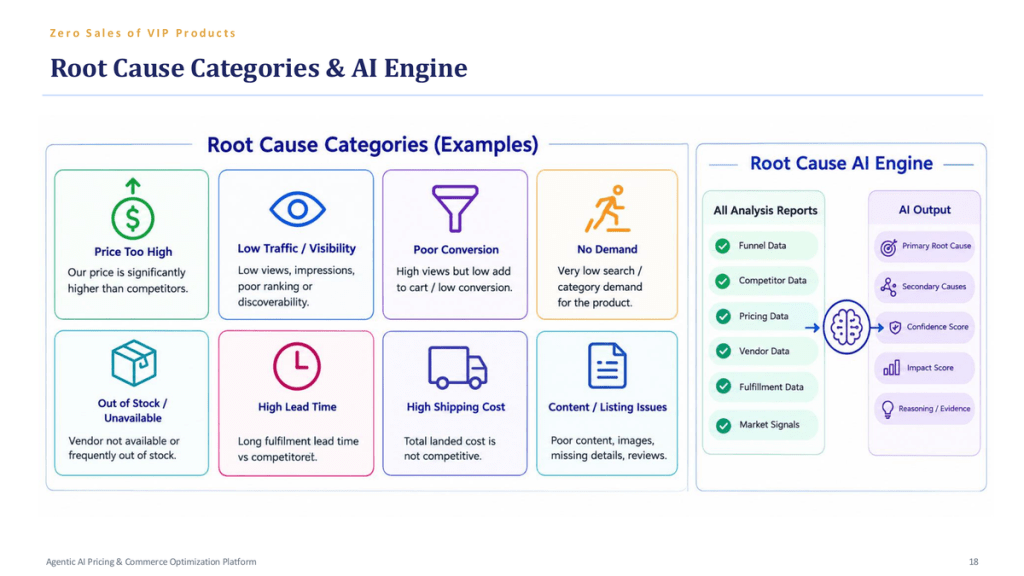
Underneath the agent layer, the actual mechanics of a single pricing decision tend to follow a fairly consistent flow: import the latest vendor cost data, validate it, build a full intelligence profile for the SKU, simulate a handful of price points, select the recommended price, apply governance and rule checks, route for human approval, and publish. It looks procedural on paper, but each step is where a specific kind of error usually creeps in if it’s skipped, and each step is typically its own small service stitched together through APIs and microservices rather than one monolithic script.
Elasticity-Aware Promotions: The MAP Problem Nobody’s Repricer Solves
Here’s a scenario that trips up almost every off-the-shelf pricing tool: a product is under a minimum advertised price agreement. The manufacturer requires the listed price to stay at or above a floor. Demand is soft. The obvious lever, cutting the price, is off the table. Now what?
This is where the distinction between pricing and promotion becomes practical rather than academic. A coupon applied at checkout, a cart-level percentage off, a bundle with a complementary product, or free shipping can sometimes change the customer’s effective transaction economics without changing the advertised listing price. However, whether a particular mechanism is permitted depends on the applicable MAP policy, vendor agreement, promotion terms, channel, and jurisdiction. That compliance check has to happen automatically, every time, because “a human will remember to check” is not a scalable control once you’re managing thousands of MAP-restricted SKUs.
A governance layer built for this needs to check, at minimum: is this SKU under MAP, what promotion types are permitted for it, is there a maximum allowed discount, what channels and date windows apply, and whether the specific offer being proposed, say, a 5% cart-level coupon with a $249 minimum order, actually stays inside all of those rules before it ever reaches a human approver. Getting this wrong isn’t just a lost sale; it can create vendor relationship, contractual, compliance, and operational risk, which is why this kind of rule enforcement tends to sit alongside broader analytics and governance work rather than living as a one-off script.
The elasticity concept still applies here, it just gets applied to the effective price after the promotion, not the sticker price. A product with elastic demand might respond well to a modest coupon. A product with inelastic demand might not need a promotion at all; the actual blocker might be availability or shipping cost, which is the next lever worth examining.
◆ ◆ ◆
The Zero-Sales Problem: When a Good Product Just Won’t Move
Every retailer with more than a few hundred SKUs has a version of this list: high-value or strategically important products sitting at zero sales for sixty, ninety, a hundred and eighty days. The standard response is a report that flags them. The useful response is figuring out why.
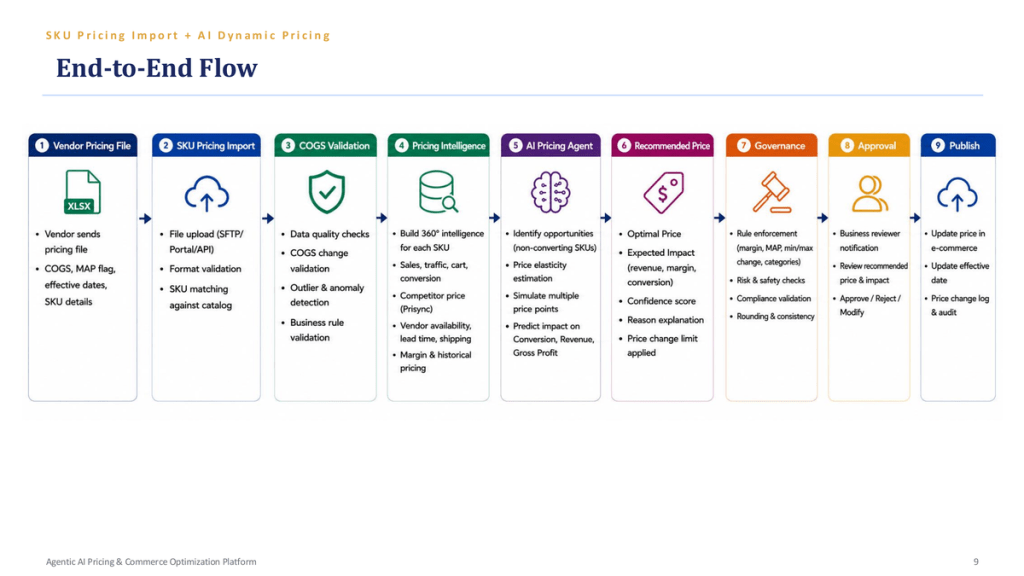
Root causes for a zero-sales SKU generally fall into a handful of buckets, and they require completely different fixes:
- Price too high relative to the market – the classic case, and the one price elasticity actually addresses directly.
- Low traffic or visibility – the product isn’t being found in search or category browsing, which no amount of repricing will fix.
- Poor conversion despite traffic – high views, low add-to-cart, which usually points to content, trust signals, or perceived value, not price.
- Out of stock or unreliable vendor availability – the product looks available but the underlying vendor can’t reliably fulfill it.
- High shipping or fulfillment cost – the sticker price is competitive, but total landed cost isn’t, which we’ll come back to.
- Genuinely low demand – sometimes the honest answer is that nobody wants it right now, and the right action is to retire or bundle it rather than reprice it indefinitely.
These causes should not be treated as mutually exclusive. A SKU can simultaneously have a competitive pricing issue, low visibility, high shipping cost, and poor vendor availability. The root-cause engine should therefore rank contributing factors rather than force every SKU into a single category.
If there’s one section of this guide most pricing conversations skip entirely, it’s this one. Customers don’t experience your product price in isolation. They experience total landed cost: product price plus shipping, handling, and any freight charges, revealed at whatever point in the checkout flow you choose to reveal it.
This interacts with elasticity in a way that’s easy to miss. A product can be priced competitively on the listing page and still convert poorly because shipping is revealed late, calculated unpredictably, or simply higher than a competitor’s. For oversized or freight-class items especially, furniture, large equipment, anything requiring special handling, shipping cost sensitivity can be a bigger driver of cart abandonment than the product price itself. Getting the freight number itself right is often a matter of properly connecting carrier rate APIs to the cart, more of an API and microservices integration challenge than a pricing one.
A useful way to think about this: segment your catalog by shipping complexity rather than treating shipping as a flat afterthought bolted onto checkout.
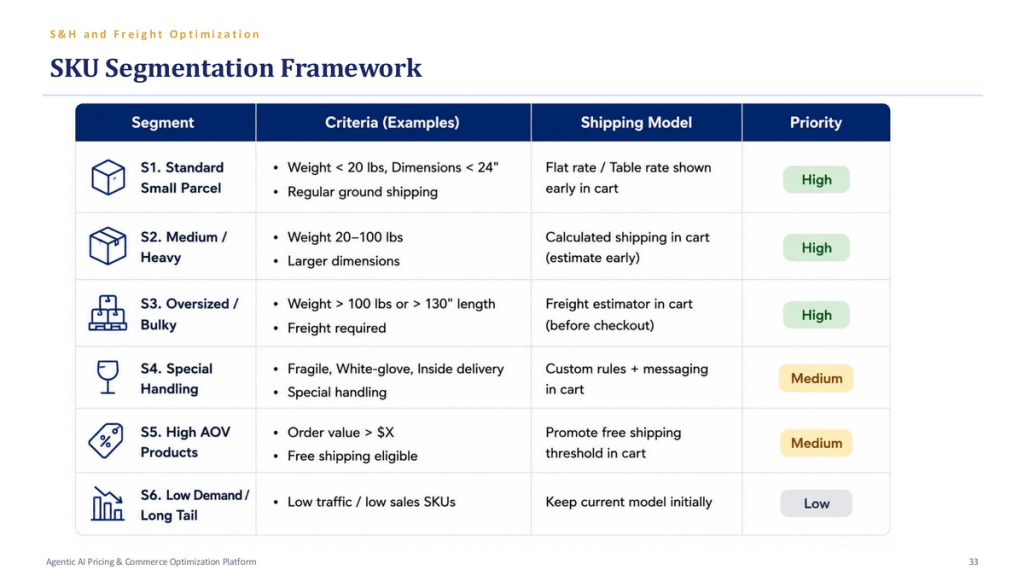
The fix that tends to matter most isn’t necessarily making shipping cheaper, sometimes it can’t be. It’s making the total cost visible earlier, before the customer has invested time filling out an address and a card number only to abandon at the reveal. That kind of change usually touches the cart and checkout experience directly, which is as much a full stack development problem, on both desktop and mobile, as it is a web and app development one, as it is a pricing question. Testing it against a control group, on a defined pilot segment, before rolling changes out catalog-wide, is the difference between a confident decision and an expensive guess, and worth validating with the same rigor a test automation practice would bring to any other production change.
◆ ◆ ◆
Putting It Together for a Vendor-Fulfilled Retailer
It’s worth walking through how these pieces fit together for a specific kind of retailer, because the generic advice, “use AI to optimize your prices,” genuinely means something different depending on the business model.
Take a specialty medical and mobility equipment retailer such as Rehabmart.com , a therapist-founded online retailer selling rehabilitation, mobility, and daily-living equipment through a broad network of manufacturing vendors and suppliers. Its public information also describes distribution-partner fulfillment for some lower-dollar SKUs, making it a useful illustration of the complexity that vendor costs and fulfillment economics can introduce into pricing decisions. This is a genuinely different pricing problem than a typical DTC brand with its own stock, and it’s a useful illustration, not a client case study, of how the pieces above come together in a real catalog.
In a drop-ship model, the retailer doesn’t hold units, so pricing decisions can’t lean on “how much stock do we need to move.” Instead, the constraints that actually matter are vendor cost of goods, vendor availability and lead time, MAP agreements and vendor pricing policies, where applicable, and the total cost of fulfilling often bulky, sometimes freight-class products like patient lifts, hospital beds, or mobility scooters. Keeping vendor cost, catalog, and order data in sync across systems is frequently an ERP integration exercise, and for retailers running on Oracle-based systems, that often means Oracle implementation work sitting right alongside the pricing build.
A pricing approach built for this kind of catalog would typically need to:
- Recommend pricing on non-MAP SKUs using elasticity, competitor position, and vendor cost together, rather than a flat competitor-match rule.
- Run root-cause analysis on high-value or strategically important products with zero sales, distinguishing a pricing issue from an availability, content, or shipping issue.
- Handle MAP-restricted products through promotions permitted by the applicable MAP policy and vendor agreement, such as coupons, bundles, or free shipping where allowed, rather than making price changes that violate those requirements.
- Treat freight-class and oversized products as their own segment, testing whether showing total landed cost earlier in the cart improves conversion, before rolling that change out broadly.
- Keep a human reviewer in the loop on higher-impact changes, with margin floors and MAP rules enforced automatically before anything reaches that reviewer.
The pattern generalizes well beyond medical equipment. It applies to any specialty retailer selling branded, MAP-protected, or freight-heavy products through third-party vendors: outdoor and patio furniture, specialty appliances, industrial supplies, pet equipment, and similar categories where margin is thin and vendor relationships matter as much as the price on the page.
Where Elasticity-Based Pricing Shows Up Beyond E-Commerce
Everything covered so far applies to a product catalog, but the underlying logic, understanding how sensitive demand is to price and building governed automation around it, isn’t unique to retail. A few places worth recognizing it:
- Travel and hospitality – airlines and hotels have run elasticity-based, time-sensitive pricing for decades. Fares change based on how far out the booking window is and how quickly seats are filling, which is elasticity applied to time instead of just price.
- Subscription and SaaS pricing – plan tiers, usage-based add-ons, and seat pricing all depend on understanding how sensitive different customer segments are to price changes, often segmented by company size or usage pattern rather than product category.
- Quick commerce and grocery delivery – delivery fees and surge windows respond to real-time demand and rider availability, a close cousin of the surge pricing most people already associate with dynamic pricing.
- Event ticketing – ticket prices for concerts and sporting events increasingly move based on expected demand curves well before the event, not just at the door.
- B2B and industrial pricing – contract and quote-based pricing can use the same elasticity signals, just measured through win rates and negotiated discounts instead of add-to-cart data.
Energy, Utilities, and Connected Devices: An Underrated Example
One of the oldest and least talked-about examples of elasticity-based pricing has nothing to do with retail at all: the electricity grid. Utilities have used time-of-use pricing, charging more during peak demand hours and less overnight, for years, precisely because electricity demand has a measurable elasticity that shifts by hour, season, and customer segment. The same logic now extends to EV charging and smart home energy management , where charging networks and connected thermostats price and schedule usage around real-time grid demand rather than a flat rate.
What makes this relevant here is the plumbing underneath it, not just the pricing logic. That kind of real-time, demand-responsive pricing depends on edge and IoT infrastructure: sensors and meters that generate a demand signal, edge-to-cloud AI that processes it close to the source, and reliable gateway and connectivity layers that get the signal back to a pricing engine in time for it to matter. Retailers with physical stores are starting to borrow the same pattern for shelf-edge pricing and inventory-aware promotions, which is really an IoT solutions problem wearing a retail pricing hat.
Industrial and B2B sellers see a version of this too: industrial communication systems on the factory floor generate the same kind of real-time demand and consumption data that, once captured through proper energy monitoring and analytics , can feed into contract pricing the same way funnel data feeds into an e-commerce elasticity model. A well-run energy management program and a well-run retail pricing program end up looking structurally similar: both are, at their core, a demand signal feeding a governed pricing decision.
The tooling looks different in each of these, but the discipline underneath is identical: measure sensitivity before you act on price, and build in guardrails before you automate.
Why Full Automation Isn’t the Goal (and Governance Isn’t Optional)
It’s tempting, once a pricing system starts producing good recommendations, to want it to just execute automatically. Resist that instinct, at least at first. Pricing mistakes compound, a bad price on a high-traffic SKU can cost real revenue or margin in a matter of hours, and vendor agreement violations carry consequences beyond the immediate sale.
A governance layer that checks every recommendation against margin floors, MAP compliance, category-specific rules, and rounding conventions before it reaches a human reviewer isn’t bureaucratic overhead. It’s what makes the rest of the system trustworthy enough to actually use, and it’s worth testing as rigorously as any other production system, which is where a dedicated quality engineering practice earns its keep. Over time, as confidence builds and a track record accumulates, low-risk categories of decisions can graduate to automatic execution within tight, pre-approved limits, a natural fit for a broader process automation strategy, while higher-impact or lower-confidence recommendations continue to route to a person. That graduated trust model, not blanket automation, is what a responsible rollout looks like. It also depends on solid operational plumbing behind the scenes, which is why this kind of program usually leans on the same MLOps and DevOps and AIOps practices used to keep any production ML system monitored, retrained, and auditable, with day-to-day application management keeping the whole thing running once it’s live.
A Practical Starting Point for Retailers
If you’re evaluating where to start, a practical enterprise architecture follows a fairly consistent sequence, regardless of category:
- Get the foundational data in one place first. SKU details, current and historical pricing, cost of goods, competitor pricing, MAP rules, and basic funnel metrics. This step is unglamorous and it’s where most initiatives quietly stall.
- Build elasticity and competitive intelligence before touching automation. Understand which products are genuinely price-sensitive before recommending changes to any of them.
- Start with recommendations, not automatic execution. Let a human approve changes for the first several cycles, and use the outcomes to calibrate confidence in the system.
- Tackle promotions and MAP-compliant offers in parallel. Don’t wait for pricing to be “done”, MAP-restricted products need a compliant lever from day one.
- Treat shipping and freight as a distinct, pilot-tested workstream. Test on a defined segment before touching the full catalog.
- Expand automation gradually, in defined, low-risk categories. Let the track record earn broader autonomy over time.
For many retailers, the first three steps can be approached within a couple of months. A typical enterprise rollout may take two to three quarters to reach a meaningfully automated and governed pricing operation, depending on data readiness, integration complexity, experimentation requirements, governance, and organizational adoption, not because the technology takes that long to build, but because the data foundation and the trust-building process genuinely need that time. Much of that foundation, in practice, is a data and cloud infrastructure question before it’s an AI question, which is where cloud services and migration work, backed by proper cloud and data security , tends to sit alongside the pricing build itself, running on the kind of enterprise platform that can support both today’s rollout and tomorrow’s expansion.
◆ ◆ ◆
Thinking about a more disciplined pricing approach for your catalog?
We work with retailers, from vendor-fulfilled specialty stores to larger multi-brand catalogs, on elasticity-based pricing, MAP-compliant promotions, and AI-powered systems that keep a human in the loop. If you want to talk through what this would look like for your business, our AI consulting and strategy team is an easy conversation to start.
Explore XFactr.AI's AI & Data Practice →- Treating elasticity as store-wide instead of SKU-specific. A single blanket discount rule ignores that some products carry it well and others don’t.
- Reacting to a single competitor’s price without checking the broader market. One outlier seller shouldn’t set your pricing strategy.
- Cutting price on inelastic, low-traffic SKUs. It rarely moves units and reliably erodes margin.
- Ignoring shipping cost as part of the pricing conversation. Total landed cost is what customers actually compare.
- Automating without a governance and MAP-compliance check first. Speed without guardrails is how vendor relationships get damaged.
- Repricing without measuring the outcome. Every price change is free data if you track what happened afterward, and wasted data if you don’t.
- Confusing correlation with causal price response. Historical price and sales data can be misleading when pricing decisions are themselves influenced by demand, promotions, seasonality, or inventory conditions. Use controlled experiments or appropriate causal methods where feasible.
◆ ◆ ◆
Quick Glossary: Dynamic Pricing Terms Worth Knowing
Dynamic pricing
Adjusting prices in response to changing conditions such as demand, cost, competition, or time, rather than setting a fixed price and leaving it alone.
Price elasticity of demand
A measure of how much quantity demanded changes in response to a change in price. High elasticity means demand is price-sensitive; low elasticity means it isn’t.
MAP (minimum advertised price)
A floor price set by a manufacturer or vendor that a retailer’s advertised price cannot go below, regardless of the retailer’s own margin math.
COGS (cost of goods sold)
The direct cost of the product itself, before markup, shipping, or operating expenses. The starting point for any margin calculation.
AOV (average order value)
The average amount spent per order, often used as a target for free-shipping thresholds and bundling strategy.
Total landed cost
The full price a customer pays, including product price, shipping, handling, and any freight charges, not just the listed sticker price.
Governance layer
The set of automated checks, margin floors, MAP compliance, business rules, that a pricing recommendation must pass before it can be published or executed.
Agentic AI
An AI system architecture where multiple specialized agents, each responsible for a narrow task, are coordinated by an orchestrator rather than relying on a single general-purpose model.
◆ ◆ ◆
Frequently Asked Questions
What is price elasticity of demand in simple terms?
It’s a measure of how much the quantity of a product people buy changes when its price changes. Highly elastic products see big swings in sales from small price moves; inelastic products barely react at all. Knowing which kind of product you’re pricing determines whether a discount will actually work.
How do you calculate price elasticity of demand?
The formula is the percentage change in quantity demanded divided by the percentage change in price. Because price and quantity typically move in opposite directions, the elasticity coefficient is usually negative; practitioners often use its absolute value when discussing the magnitude of price sensitivity. In practice, most retailers estimate it from historical price changes, competitor price gaps, and conversion data rather than computing it from one clean data point.
Why does price elasticity matter for dynamic pricing?
Without an elasticity estimate, a pricing system is guessing. Elasticity tells you which products will actually sell more if you lower the price and which ones won’t move at all, so you can protect margin on inelastic goods and use price as a real lever on elastic ones.
Is dynamic pricing the same as surge pricing?
No. Surge pricing is a narrow, demand-spike version of dynamic pricing. E-commerce dynamic pricing is broader, it includes competitor-based repricing, elasticity-based optimization, promotions, and shipping cost adjustments, often moving gradually and within predefined guardrails rather than spiking sharply.
Is dynamic pricing legal for online retailers?
Yes, dynamic pricing is generally permitted, but the legal and regulatory requirements depend on the jurisdiction, product category, pricing practice, and implementation. Retailers should consider MAP or other vendor agreements, advertising and reference-pricing rules, consumer-protection requirements, privacy considerations, and antitrust restrictions. Competitors must independently determine their own prices; agreements or coordination among competitors to fix or stabilize prices can violate antitrust law.
Why does dynamic pricing fail for vendor-fulfilled or drop-ship retailers specifically?
Many traditional repricing approaches are designed primarily around product price and competitive position, while vendor-fulfilled retailers often need additional inputs such as vendor cost, availability, fulfillment lead time, shipping economics, and MAP requirements. Drop-ship retailers need pricing logic built around those inputs instead, a different set of signals than typical inventory-based repricers are designed for.
Does dynamic pricing apply outside of e-commerce?
Yes. Airlines and hotels have used elasticity-based pricing for decades, subscription and SaaS companies use it for plan and usage-based pricing, quick commerce apps adjust prices by time and demand, utilities have used time-of-use electricity pricing for years, and EV charging networks now price by real-time grid demand. The underlying logic is the same across all of them.
How often should an online retailer update prices?
There’s no universal number. Elastic, highly competitive categories may warrant weekly or even daily review. Inelastic, specialty, or MAP-restricted categories often only need review monthly or when cost, competitor pricing, or demand signals meaningfully change.
What data should a retailer gather before starting elasticity-based pricing?
Historical price and sales data per SKU, current cost of goods, competitor pricing, site traffic and conversion, cart abandonment, and any MAP or promotional policy rules. Vendor lead time and shipping cost data round this out for more mature programs.
Pricing is one of the few levers in retail that touches revenue, margin, and customer trust all at once, which is exactly why it deserves more rigor than a spreadsheet and a gut call. Price elasticity isn’t a concept to cite in a meeting and then ignore; it’s the difference between a pricing strategy that compounds and one that just moves numbers around every quarter. Get the elasticity right, build the governance in from day one, and the automation layer is often easier to implement than getting the data, experimentation, governance, and organizational trust right.
Sharath Kumar A
Chief AI Architect, XFactr.AI
Sharath leads AI architecture at XFactr.AI, where he and his team design agentic AI systems for pricing, commerce optimization, and retail automation. His work focuses on making AI pricing recommendations explainable and governed, not just automated. Explore the team's broader AI and ML development work or enterprise AI applications.