
As industries continue to embrace digital transformation, the demand for faster, smarter, and more reliable decision-making has never been greater. Artificial Intelligence (AI) has become a key driver of innovation across manufacturing, energy, logistics, healthcare, and automotive sectors. However, traditional cloud-based AI systems often struggle with latency, bandwidth limitations, and data privacy concerns.
This is where Edge Computing is transforming industrial AI. Processing data closer to the source, whether it’s a machine, sensor, or industrial device, edge computing enables businesses to make real-time decisions without relying entirely on the cloud.
At Xfactr.AI, we help enterprises leverage Edge AI solutions that combine artificial intelligence, IoT, and advanced analytics to improve operational efficiency, reduce downtime, and accelerate digital transformation. This article explores the key benefits of edge computing for industrial AI and why it is becoming an essential technology for modern industries.
What is Edge Computing?
Edge computing is a distributed computing model that processes and analyzes data near the point where it is generated instead of sending all data to centralized cloud servers.
For industrial environments, this means AI models can run directly on:
- Smart sensors
- Industrial machines
- Robotics
- PLCs (Programmable Logic Controllers)
- Edge gateways
- Manufacturing equipment
Instead of waiting for data to travel to the cloud and back, AI-powered decisions happen almost instantly.
Why Industrial AI Needs Edge Computing
Industrial environments generate massive amounts of data every second.
Examples include:
- Machine vibration data
- Temperature readings
- Video surveillance
- Production line monitoring
- Predictive maintenance sensors
- Quality inspection cameras
Sending all this data to the cloud creates several challenges:
- Higher latency
- Increased bandwidth costs
- Network dependency
- Security concerns
- Delayed decision-making
Edge computing addresses these issues by bringing AI directly to the devices generating data.
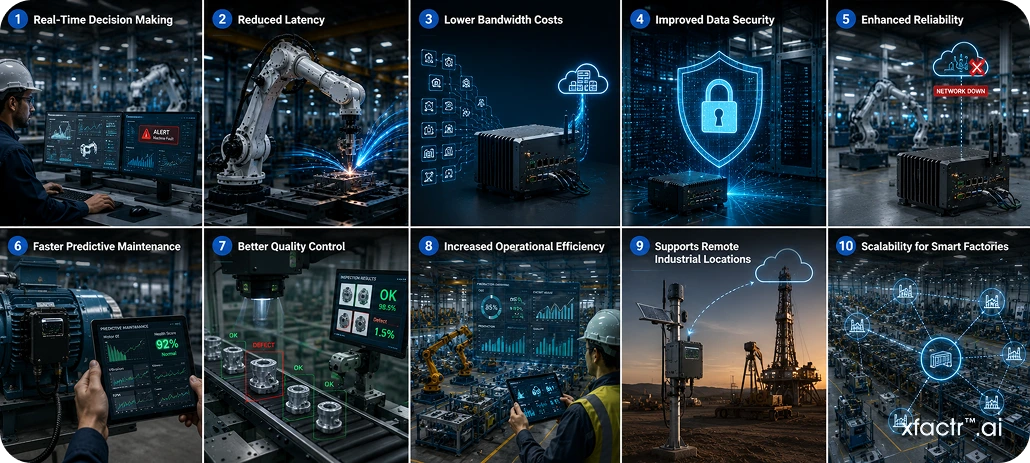
Key Benefits of Edge Computing for Industrial AI
1. Real-Time Decision Making
Industrial operations require immediate responses.
For example:
- Detecting equipment failure
- Identifying defective products
- Preventing machine collisions
- Monitoring worker safety
Edge AI processes data locally in milliseconds, enabling instant decision-making without waiting for cloud responses.
This significantly improves production efficiency while reducing operational risks.
2. Reduced Latency
Cloud-based AI depends on internet connectivity.
Even a delay of a few hundred milliseconds can impact industrial operations.
Edge computing minimizes latency because data never has to travel long distances.
This is particularly important for:
- Autonomous robots
- Industrial automation
- Smart manufacturing
- Real-time quality inspection
- Autonomous vehicles
The faster the response, the safer and more efficient industrial operations become.
3. Lower Bandwidth Costs
Industrial IoT devices generate terabytes of data every day.
Uploading all this information to the cloud can become extremely expensive.
Edge computing filters and processes data locally.
Only valuable insights or summarized information are transmitted to cloud platforms.
This dramatically reduces:
- Internet bandwidth usage
- Cloud storage costs
- Data transfer expenses
Organizations can optimize infrastructure costs while maintaining high-performance AI systems.
4. Improved Data Security
Sensitive industrial data often contains:
- Manufacturing processes
- Product designs
- Operational metrics
- Customer information
Keeping this data at the edge reduces exposure to cyber threats.
Since data remains within the local network, businesses have better control over sensitive information.
Edge computing also supports compliance with industry regulations that require local data processing and storage.
At Xfactr.AI, security is integrated into every AI solution through secure edge architectures, encrypted communication, and enterprise-grade protection.
5. Enhanced Reliability
Industrial facilities cannot afford to reduce downtime due to internet outages.
Edge AI continues functioning even when cloud connectivity is interrupted.
Machines can still:
Detect faults
- Monitor production
- Analyze quality
- Trigger alerts
- Execute automated workflows
This ensures uninterrupted business operations even in remote industrial locations.
6. Faster Predictive Maintenance
Predictive maintenance is one of the biggest applications of Industrial AI.
Edge devices continuously monitor:
- Motor performance
- Temperature
- Pressure
- Vibration
- Energy consumption
AI algorithms detect abnormal patterns before failures occur.
This allows maintenance teams to repair equipment before costly breakdowns happen.
Benefits include:
- Reduced downtime
- Lower maintenance costs
- Longer equipment lifespan
- Increased production efficiency
7. Better Quality Control
Modern manufacturing relies heavily on computer vision.
High-resolution cameras inspect products for:
- Surface defects
- Missing components
- Incorrect assembly
- Dimension errors
Processing these images in the cloud can create delays.
Edge AI analyzes images instantly, allowing defective products to be removed immediately from production lines.
This improves:
- Product quality
- Customer satisfaction
- Manufacturing efficiency
- Waste reduction
8. Increased Operational Efficiency
Industrial AI combined with edge computing automates repetitive processes while continuously optimizing production.
Examples include:
- Intelligent scheduling
- Energy optimization
- Inventory monitoring
- Production forecasting
- Automated process adjustments
Businesses gain greater visibility into operations while improving productivity across departments.
9. Supports Remote Industrial Locations
Many industries operate in areas with limited internet connectivity.
Examples include:
- Mining
- Oil and gas
- Offshore facilities
- Renewable energy farms
- Construction sites
Edge computing enables AI applications to function independently of cloud connectivity.
Data synchronization can occur whenever network access becomes available.
10. Scalability for Smart Factories
As organizations expand their Industrial IoT infrastructure, managing thousands of connected devices becomes increasingly complex.
Edge computing provides scalable architecture by distributing computing power across multiple locations.
This supports:
- Smart factories
- Industry 4.0 initiatives
- Autonomous manufacturing
- Intelligent supply chains
- Connected industrial ecosystems
Businesses can scale AI deployments without overwhelming centralized cloud systems.
Real-World Applications of Edge Computing in Industrial AI
Industries worldwide are adopting Edge AI for various use cases, including:
Manufacturing
- Automated quality inspection
- Predictive maintenance
- Robotic automation
- Production optimization
Logistics
- Fleet monitoring
- Warehouse automation
- Robotic automation
- Smart inventory management
Energy & Utilities
- Grid monitoring
- Equipment diagnostics
- Asset performance management
- Predictive maintenance
Automotive
- Autonomous manufacturing
- Vehicle testing
- Robotics
- Assembly line optimization
Healthcare Manufacturing
- Pharmaceutical quality inspection
- Equipment monitoring
- Cold chain monitoring
- Process automation
How Xfactr.AI Helps Businesses Implement Edge AI
At Xfactr.AI, we specialize in delivering intelligent industrial solutions that combine Artificial Intelligence, Machine Learning, IoT, and Edge Computing to solve complex operational challenges.
Our Edge AI capabilities include:
- AI-powered predictive maintenance
- Computer vision solutions
- Industrial IoT integration
- Real-time analytics
- Smart manufacturing platforms
- Intelligent automation
- Data engineering
- Cloud and edge integration
- AI model deployment at the edge
- Custom enterprise AI solutions
Our team works closely with organizations to design scalable, secure, and future-ready AI architectures that enhance productivity while reducing operational costs.
Whether you’re modernizing a manufacturing plant or building an Industry 4.0 ecosystem, Xfactr.AI provides the expertise needed to successfully deploy edge computing solutions.
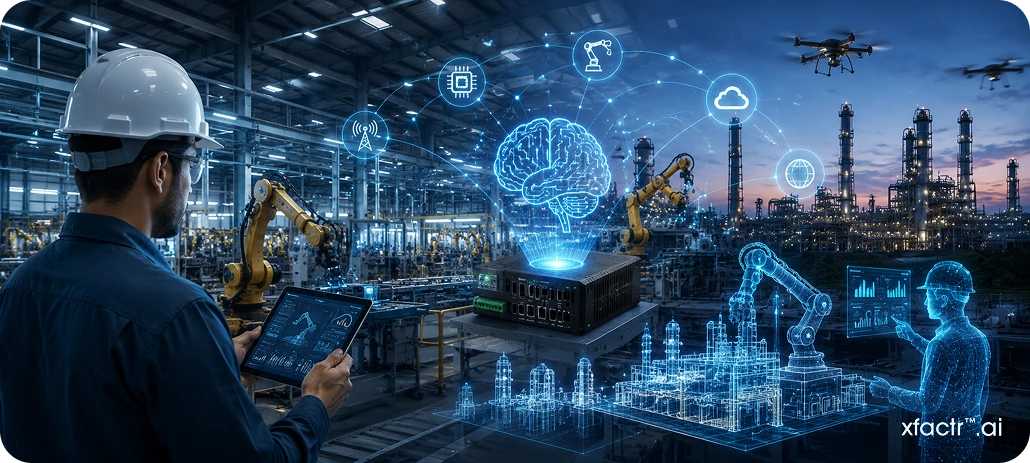
Future of Edge Computing in Industrial AI
The future of Industrial AI lies in decentralized intelligence.
As AI models become more sophisticated and IoT devices continue to expand, edge computing will become the foundation of intelligent industrial ecosystems.
Emerging technologies such as:
- 5G connectivity
- TinyML
- Autonomous robotics
- Digital Twins
- Industrial Metaverse
- Generative AI
- Smart factories
will further accelerate the adoption of Edge AI across industries.
Organizations that invest today will gain a significant competitive advantage through faster decision-making, improved operational efficiency, and enhanced customer satisfaction.
Final Thought
Edge computing is redefining how industries leverage Artificial Intelligence by bringing data processing closer to where it is generated. From real-time decision-making and predictive maintenance to enhanced security, reduced latency, and lower operational costs, Edge AI enables organizations to operate more efficiently and respond faster to changing conditions.
As industries move toward Industry 4.0, adopting Edge AI is no longer just an innovation—it is a strategic necessity. Xfactr.AI empowers businesses with scalable, secure, and intelligent Edge AI solutions tailored to their operational needs. By combining AI, IoT, and advanced analytics, Xfactr.AI helps organizations unlock greater efficiency, minimize downtime, and build future-ready industrial ecosystems.
Start Your AI Transformation Today
FAQ
1. What is Edge Computing in Industrial AI?
Edge Computing is a technology that processes AI data closer to industrial devices, machines, or sensors instead of relying solely on cloud servers. This enables faster and more efficient decision-making.
2. How does Edge Computing improve industrial operations?
It reduces latency, enables real-time analytics, improves predictive maintenance, lowers bandwidth costs, enhances security, and ensures continuous operations even during network disruptions.
3. Which industries benefit the most from Edge AI?
Industries such as manufacturing, logistics, automotive, energy, healthcare, mining, and oil & gas benefit significantly from Edge AI through improved automation, monitoring, and operational efficiency.
4. How does Xfactr.AI support Edge AI implementation?
Xfactr.AI provides end-to-end Edge AI solutions, including industrial IoT integration, predictive maintenance, computer vision, real-time analytics, AI model deployment, and intelligent automation tailored to business requirements.
5. Is Edge Computing replacing cloud computing?
No. Edge computing complements cloud computing by handling time-sensitive data locally while the cloud manages long-term storage, large-scale analytics, and centralized AI model management. Together, they create a powerful hybrid architecture for industrial AI.
Blogs