

Blog
Agentic AI: What’s
Really Happening in the Industry Today
Agentic AI is changing more than
just tools—it’s changing how decisions are made
Agentic AI is changing more than just tools—it’s changing how decisions are made and work gets done.
Most of us have seen what generative AI can do with a simple prompt. But what if the system didn’t wait for you? What if it could plan, act, and adjust on its own?
That’s what agentic AI is about. We recently worked with a startup that automated their entire onboarding flow using an agentic model. What used to take three days of back-and-forth emails now runs on its own—with 80% less human effort.
If your business is still watching from the sidelines, now’s the time to lean in.
This blog breaks down what agentic AI is, how it’s different from generative AI, the trends shaping its rise, real-world examples, and how it’s changing the future of work.
What is Agentic AI?
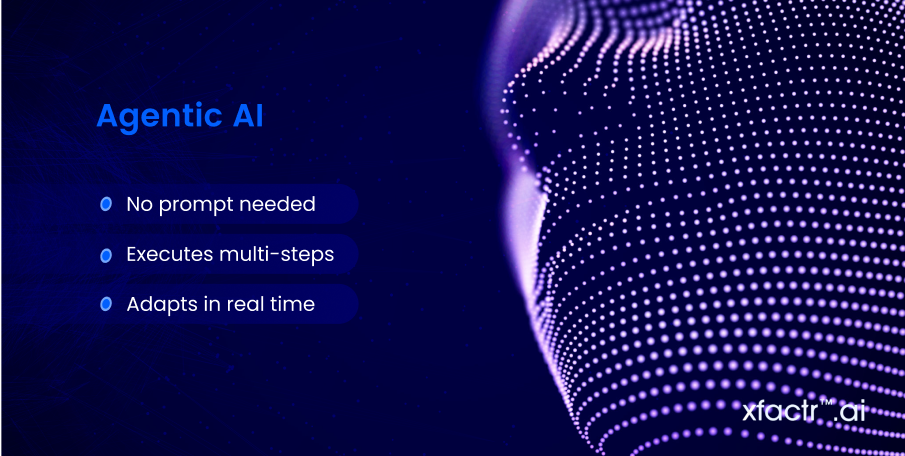
Agentic AI refers to systems that act independently based on defined objectives. Unlike traditional or generative AI, which needs user input, agentic AI can plan, execute, and adapt across multi-step workflows without constant oversight.
It’s more than just automation. Agentic AI can coordinate tools, navigate decision-making, and adjust to real-world changes in real time.
Agentic AI vs Generative AI
| Feature | Generative AI | Agentic AI |
|---|---|---|
| Needs Prompt? | Yes | No |
| Executes Tasks? | Limited | Yes, multi-step |
| Adapts in Real-Time? | No | Yes |
Generative AI creates content when asked. Agentic AI takes the lead—researching, planning, acting, and adapting along the way.
For example, generative AI might draft a marketing email. Agentic AI would research the campaign, generate multiple versions, test them, and schedule deployment.
Key Trends in Agentic AI
- Autonomous Workflows: Tools like AutoGPT and MetaGPT break down complex tasks into sequences and execute them with little to no human input.
- Enterprise Deployment: McKinsey’s 2023 report shows 55% of organizations use AI in at least one business function, with growing interest in agentic systems.
- Multimodal Intelligence: GPT-4 and Gemini process diverse inputs like text, code, images, and tables—boosting agentic systems' flexibility.
- Enterprise Decision Support: IBM Watsonx and Salesforce Einstein use real-time analytics to guide high-impact decisions.
- Responsible AI Controls: Companies are embedding audit trails, approval workflows, and fail-safes to deploy agents safely.
Examples of Agentic AI in Action
- Healthcare: Researchers using DeepMind’s AlphaFold have seen a major breakthrough in predicting protein structures. It’s not just faster—it’s changing how drug discovery begins. Tasks that used to take months in a lab can now be done in hours, which helps scientists move from research to results much quicker.
- Finance: JPMorgan’s LOXM trading engine isn’t waiting for trader input. It reads market signals, makes decisions in real time, and executes trades with incredible precision. For institutions handling billions, even a small time gain means a competitive edge.
- E-commerce: Shopify Magic helps sellers do more with less. From writing product descriptions to testing what works best, it uses agentic logic to take over tasks that eat up time. This lets sellers focus on growth, not busywork.
- Customer Support: Forethought’s Resolve platform is changing how support teams work. It doesn’t just route tickets—it solves them. By categorizing and responding to queries without needing a human in the loop, it gives support staff time back and improves response quality.
- DevOps: Tools like CrewAI and AutoGPT are now helping developers do more in less time. They assist in writing, testing, and deploying code within live environments. For teams shipping daily, this is like having an extra developer who never takes a break.
Benefits of Agentic AI in Business
- Faster Execution: Agents automate steps that usually require back-and-forth coordination. This means projects can move faster from ideation to delivery without waiting on multiple approvals or handoffs.
- Smarter Decisions: They evaluate real-time data and adjust as needed. With access to dynamic insights, agentic systems reduce human bias and help teams act based on what’s happening now—not what happened last quarter.
- Lower Costs: Teams save hours by offloading routine and repetitive tasks. That time savings adds up—especially in areas like operations, finance, and customer support—translating to significant savings over the long term.
- Easy Scalability: Agentic systems adapt quickly to new processes and data environments. Businesses can introduce these systems into one department, test their performance, and then scale them gradually without heavy infrastructure changes.
Beyond these, agentic AI can also reduce decision fatigue, boost employee morale by eliminating monotonous tasks, and improve consistency across teams. When implemented thoughtfully, it becomes a force multiplier—augmenting human capabilities rather than replacing them.
Accenture’s 2024 report emphasizes that agentic AI is key to achieving intelligent operations.

How Agentic AI Is Changing the Workplace
Agentic AI allows teams to shift from execution to oversight. Employees become supervisors and validators, while the AI handles the actual operations.
This transition means soft skills—like problem-solving, communication, and ethical thinking—become more critical. At the same time, businesses must build internal policies to manage and monitor AI-driven decisions.
Conclusion
Agentic AI isn’t a passing trend—it’s already reshaping how companies operate, compete, and grow. From automating tedious processes to enabling faster, smarter decision-making, these systems are changing the game for teams that embrace them early.
If you’re unsure where to begin, start small. Choose one clear use case, put it into action, see how it performs, and build from there.
Ready to explore what agentic AI could do for your business? Contact XFactr™. AI: We’ll help you identify the right opportunity, design a quick pilot, and build a system that drives measurable results.