

Blog
A Complete Guide
to Different Types of Agents in AI
AI is no longer a thing
of the future. It is here, everywhere
AI is no longer a thing of the future. It is here, everywhere these days, From voice assistants like Alexa to self-driving cars, AI is powered by something called agents. But what exactly are agents in AI, and why do they matter so much?
The word “agent” may sound super technical and confusing. But, to make it easier for you, think of an AI agent as a smart decision-maker. It observes its surroundings, thinks about what it sees, and then acts to reach a goal. For example, Google Maps works as an agent when it studies traffic conditions and suggests the fastest route. Without these agents, AI systems would not be able to learn, adapt, or take actions on their own.
In this guide, let’s break down the different types of agents in AI, explore real-life examples, and understand how they are built.
What Are AI Agents?
- Perceive - take in information from the environment.
- Decide - process the taken information and choose the best action.
- Act - carry out that action to reach the goal.
For example of agent in AI: a chatbot in customer service reads a question, processes it, and replies with the right answer according to data.
How Many Types of Agents Are There in Artificial Intelligence?
The answer to the question, how many types of agents are there in artificial intelligence? depends on how we classify them, but in most standard AI studies, we talk about five main types of AI agents and they are:
- Simple Reflex Agents
- Model-Based Reflex Agents
- Goal-Based Agents
- Utility-Based Agents
- Learning Agents

1. Simple Reflex Agents
These are the most basic kind of AI agents. Simple reflex agents only look at what’s happening right now and respond to it.
Think of a thermostat. When it senses the temperature is too hot, it turns on the air conditioner. It doesn’t remember yesterday’s weather or predict tomorrow’s but just reacts to the current condition. While they’re useful for simple jobs, simple reflex agents fall short in messy or dynamic environments.
2. Model-Based Reflex Agents
Model-based reflex agents take things a bit further. They don’t just react; they actually build a small “memory” of what’s going on. This model helps them make better choices.
A self-driving car is a great example. It can’t see the whole road at once, but it remembers where cars and pedestrians were a moment ago. That memory helps it act smarter and safer than a simple reflex system. And, this makes them more reliable in complex environments.
3. Goal-Based Agents
Goal-based agents don’t only react to inputs. Instead, they aim for a specific target and pick actions that bring them closer to it.
Google Maps is a good example. It doesn’t just react to where you are right now. It looks at your destination and figures out the best route to get there. It may even compare different paths before choosing the fastest one. This problem-solving skill makes them stronger than reflex agents, especially in situations with many possible outcomes.
4. Utility-Based Agents
Utility-based agents go one step further. They don’t just think about reaching a goal but also about how good or useful the outcome will be.
Take Uber, for example. The app doesn’t simply send the closest driver. It considers distance, cost, and traffic, and then picks the option that balances everything. This is why utility-based agents are more people-friendly, because they aim for both efficiency and user satisfaction.
5. Learning Agents
Learning agents are the most advanced type of all. They can actually improve over time by learning from past experience.
Netflix recommendations are a clear case. The more shows you watch, the better its suggestions get. Same with Amazon showing products you might like. These systems adapt to your habits and preferences. Because of this, learning agents are often seen as the future of AI.
According to a report by McKinsey (2023), companies using advanced AI systems like learning agents saw productivity boosts of up to 40%, showing how powerful this type of agent can be in the real world.
Examples of Agents in AI
- Virtual Assistants (like Siri or Alexa): They listen to your voice, understand your request, and act, whether it’s playing music or setting reminders.
- Self-Driving Cars: These cars act as agents by sensing the environment, predicting obstacles, and making driving decisions.
- Recommendation Systems: Platforms like Netflix and Amazon suggest movies or products by learning from your past choices.
How to Create an AI Agent?
- Define the Goal: Decide what problem the agent is going to solve.
- Collect Data: Provide real-world or simulated data for the agent to learn from.
- Choose the Model: Select algorithms (rule-based, ML, or deep learning) that fit the task.
- Train the Agent: Feed the data and let the agent improve over time.
- Test & Improve: Place the agent in real situations, measure performance, and refine it.
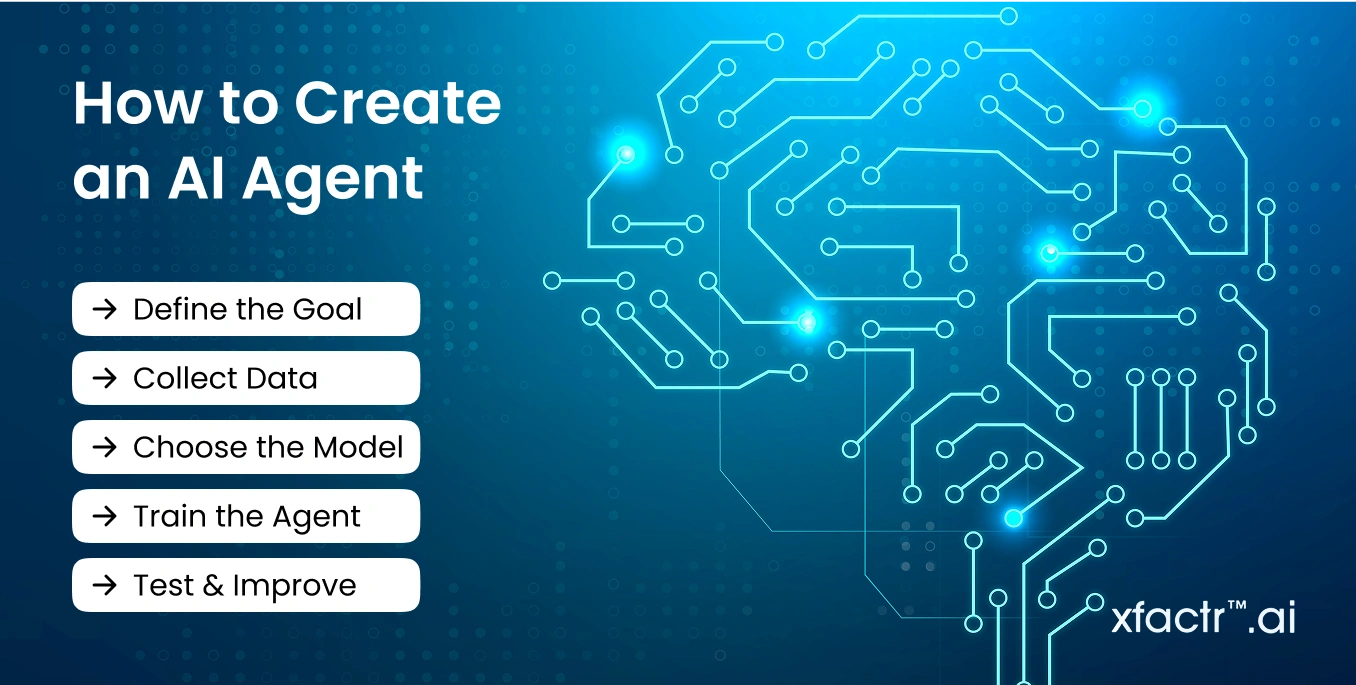
In short, if you want to know how to create an AI agent, think of it like teaching a child — start simple, give feedback, and let it grow smarter with experience.
Conclusion
AI is transforming industries, homes, and even the way we make decisions. The different types of agents in AI are at the heart of this change. From simple rule-based systems to advanced self-learning models, each agent has its own role in the AI journey.
In short, AI agents are not just about machines making choices; they are about creating systems that can adapt, grow, and help us solve real-world problems faster than ever. And, if it’s confusing to choose the right type of AI agent for your different business operations, then contact XFactr™.AI, today!