
Case Study
Enhancing Operational Efficiency: A Deep Dive into Enterprise-Scale Solutions for Well Anomaly Detection
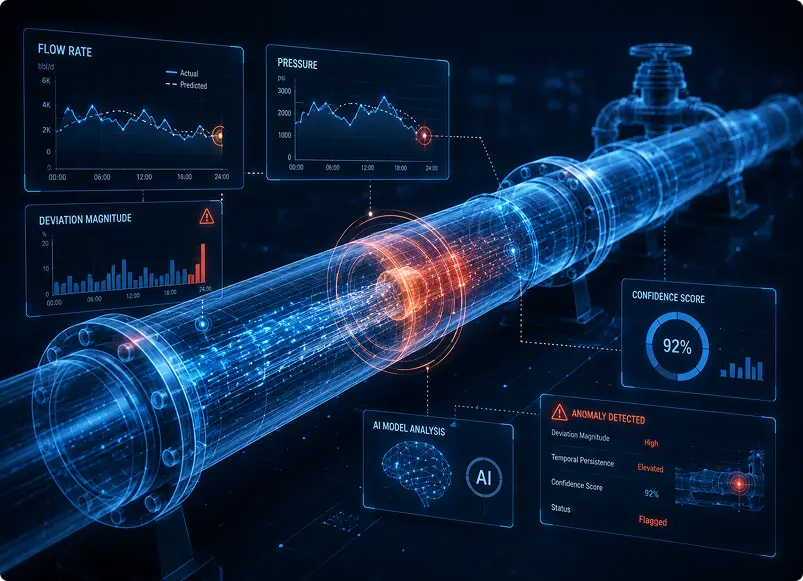
This project launched an enterprise-grade Well Performance Anomaly Detection platform, continuously monitoring 15,000+ oil & gas wells across ESP, Natural Flow, Gas Lift, PCP, and Rod Pump systems. Ingesting Virtual Flow Meter (VFM) production data alongside pressures, temperatures, pump metrics, and facility constraints, the solution fuses ML models with physics-informed diagnostics.
Business Problem
It delivers statistically significant anomaly detection, precise production deferment quantification, automated root cause classification, and prioritized, explainable insights for engineers. Cloud-native architecture ensures daily automated updates, retraining, full auditability, and seamless scalability for proactive optimization.
- Delayed anomaly detection
- Reactive rather than proactive interventions
- Extended production deferment
- High engineering workload for root cause analysis
Objectives
The solution had to address several complex and demanding requirements:
- Deploy continuous, automated monitoring for all wells with daily refresh cycles
- Achieve ≥90% accuracy in deviation detection against historical ground truth
- Implement automated root cause classification with ≥80% accuracy
- Quantify production deferment with confidence intervals
- Validate scalability for 15,000+ wells across lift types
All objectives were achieved as part of the completed solution.
Solution Overview
The platform implements a model-driven diagnostic layer that continuously evaluates well performance by comparing actual production behavior against predicted baseline performance. Performance deviations exceeding adaptive thresholds are flagged as anomalies and processed through a hybrid diagnostics engine, combining supervised machine learning with rule-based domain intelligence to identify the most probable root cause.
High-Level Workflow
- Predict expected production behavior
- Quantify deferment magnitude
- Compare actual vs. predicted performance
- Classify root cause with confidence
- Detect statistically significant deviations
- Generate actionable, explainable outputs
System Architecture
Anomaly Detection & Deferment Quantification
Detection Strategy
- Compare actual flow rates against predicted baseline values
- Evaluate deviation magnitude at well and time-interval granularity
- Apply statistical significance thresholds to suppress noise
Outputs
- Deviation magnitude (absolute and relative)
- Temporal persistence of anomalies
- Confidence score for deviation validity
This ensures anomalies reflect true performance degradation, not transient noise.
Root Cause Classification Engine
Once an anomaly is detected, the system performs an automated root cause diagnosis using a hybrid ML + domain-rule framework.
All features are derived from a single timestamp + weather snapshot, guaranteeing inference safety and eliminating data leakage.
Machine Learning Layer
- Supervised classifiers (Random Forest, Gradient Boosted Models)
- Trained on historical well behavior and labeled events
- Capture nonlinear interactions across production and operational parameters
Domain-Driven Intelligence
- Pressure drop patterns: Inflow constraints
- Tubing / flowline signatures: Outflow restrictions
- Casing / tubing head pressure anomalies: Choke-related issues
- Correlated deviations across multiple wells: Facility-level constraints
Root Cause Taxonomy
Detected anomalies are classified into four primary diagnostic categories, each decomposed into engineering-relevant sub-causes:
Inflow
- Skin buildup
- Reduced productivity index (PI)
- Perforation blockage
- Water cut increase
- Sanding
- Abnormal reservoir pressure behavior
Choke
- Abnormal pressure drops
- Flow restrictions
- Erosion-related effects impacting flow stability
Each classification is accompanied by a confidence score, enabling risk-based prioritization.
Outflow
- Tubing restrictions
- Leaks and integrity issues
- Artificial lift malfunctions
- Depositions and sand buildup
- Abnormal pressure responses
Facility
- Surface facility constraints
- Delivery pressure limitations
- Shared line restrictions
- Leaks and deposition-related losses
Structured Diagnostic Outputs
For every detected anomaly, the system generates:
These outputs are designed to integrate directly into engineering workflows.
- Expected vs. actual production
- Confidence score per diagnosis
- Quantified production deferment
- Explainable indicators supporting the classification
- Root cause category and sub-cause
System Architecture Highlights
- Modular, cloud-native design
- Fault-tolerant and horizontally scalable
- Supports multi-lift, multi-asset portfolios
- Daily automated retraining and drift resilience
- Full explainability and auditability
Tools & Technologies
- Data & ML: Python, pandas, numpy, scikit-learn, polars
- Deployment: FastAPI
- Infrastructure: Azure ML GPU Cluster
Key Outcomes
- Automated detection and classification of well performance anomalies
- High-confidence root cause identification
- Consistent, model-based deferment quantification
- Explainable diagnostics aligned with production engineering logic
- Enterprise-scale validation for portfolio-wide deployment
Business Impact
- Early identification of underperformance, reducing production deferment
- Improved production reliability and asset utilization
- Faster root cause diagnosis and intervention prioritization
- Accelerated shift from reactive monitoring to proactive well management
- Reduced manual surveillance and engineering workload
The Final Thoughts
This solution demonstrates how hybrid AI, physics-informed diagnostics, and scalable cloud architecture can transform traditional well surveillance into a continuous, intelligent production optimization system.
By delivering accurate anomaly detection, quantified production losses, explainable root cause insights, and enterprise-scale automation, the platform provides operators with the tools needed to maximize production performance across complex asset portfolios.
The XFactr.ai Advantage: From Chaos to Control
Manual surveillance fails at scale. XFactr.ai provides portfolio-wide visibility:
XFactr.ai Crushes These Pain Points:
- Instant Alerts vs delayed anomaly spotting
- 80%+ Root Cause Accuracy vs manual guesswork
- Daily Retraining vs stale models
- Quantified BPD Losses with confidence intervals
XFactr.AI's Signature Hybrid Intelligence
Powered by Xfactr.AI Innovation:
- Baseline Prediction from multi-sensor data
- Statistical Deviation Detection (adaptive thresholds)
- Hybrid Engine: Random Forest + Gradient Boosting + Physics Rules
- Root Cause Taxonomy: Inflow (skin buildup), Outflow (leaks), Choke, Facility
XFactr.AI Outputs: Expected vs actual charts, deferment dollars, prioritized fixes all audit-ready.
From Reactive to Predictive
Xfactr.AI transforms manual surveillance into continuous, intelligent production optimization slashing deferment, accelerating interventions, and maximizing asset uptime.