

Blog
Why Artificial Intelligence
in Healthcare Sector Matters More Than Ever
Imagine a patient waiting for days
with tests piling up and critical signs
Imagine a patient waiting for days with tests piling up and critical signs slipping through the cracks. Sounds alarming? But that’s the reality many hospitals are facing today.
Every missed diagnosis or delayed decision costs precious time, resources, and sometimes even lives. What’s more frustrating is that the healthcare teams are swamped in and juggling with mountains of data while trying to keep up with patient care.
This is where artificial intelligence in healthcare sector will help out. Today, most of the hospitals and clinics are using AI to detect early warning signs, speed up diagnostics, and create custom treatment plans. The importance of AI in healthcare is undeniable. It’s helping teams make sense of complex data, reduce errors, and save countless hours that can be spent directly with patients.
In this blog, we’ll dive into how artificial intelligence in healthcare sector is transforming patient care, hospital operations, and why embracing it now can mean the difference between staying ahead or falling behind.
In this blog you’ll learn:
- Why AI is becoming essential for healthcare providers today
- How it enhances decision-making and patient care
- The roles AI plays in diagnostics, operations, and treatment
- Key applications of artificial intelligence in healthcare
- Real-world examples showing AI’s impact
- Challenges, ethical considerations, and future trends
- How to integrate AI into your healthcare practice
The Rising Importance of AI in Healthcare
Artificial intelligence in healthcare sector is not just a fancy trend. It is actually becoming the backbone of modern healthcare. From big hospitals to small specialty clinics, AI is helping doctors and staff make smarter decisions, give better care to patients, and run hospitals more efficiently.
According to Accenture, AI in healthcare could save the US healthcare system around $150 billion every year by 2026. And it’s not only the large hospitals that are using it. Even smaller clinics, outpatient centers, and telemedicine services are starting to see how AI can improve patient care and reduce costs for everyday operations.
Here’s why it is so important right now:
- Healthcare needs are growing fast, but resources like staff and time are limited
- AI can look at huge amounts of data in seconds, much faster than any human could
- Hospitals and clinics that start using AI early get a big advantage in efficiency and patient satisfaction
This change isn’t something that’ll happen tomorrow. It is happening right now as you’re reading this. It’s already affecting healthcare, decision making, and giving an edge to those adopting artificial intelligence in healthcare. Understanding the importance of AI in healthcare will help healthcare leaders to stay ahead in the game.
What Is the Role of AI in Healthcare?
The role of AI in healthcare is all about practical applications that support professionals and patients. AI helps healthcare teams make faster, smarter, and more informed decisions while giving them space to do what they’re best at.
The role of AI in healthcare includes:
- Diagnostic support: AI analyzes medical imaging such as X-rays, MRIs, and CT scans and help radiologists detect conditions more accurately.
- Predictive analytics: AI can identify patients at risk of complications, readmissions, or even outbreaks in certain areas, enabling proactive care.
- Robotic surgeries and precision medicine: AI can guide surgeons during operations and it also helps create customized treatment plans based on the patient history.
- Virtual health assistants: AI-powered chatbots provide guidance, appointment reminders, and pre or post treatment instructions for patients.
Applications of Artificial Intelligence in Healthcare
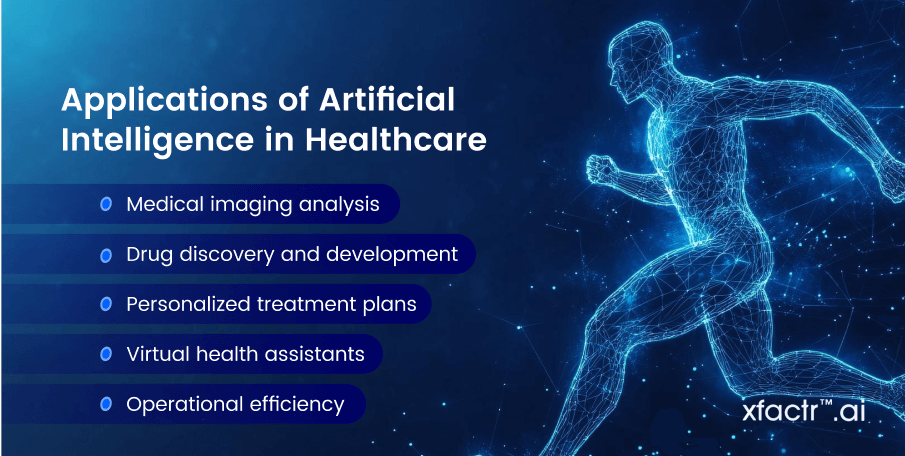
Some key applications of artificial intelligence in healthcare include:
- Medical imaging analysis: AI reviews thousands of scans quickly, highlighting potential issues for doctors to review. Early detection of cancers or fractures can save lives.
- Drug discovery and development: AI can analyze chemical compounds, predict effectiveness, and identify potential side effects, speeding up research and reducing costs.
- Personalized treatment plans:</b. AI combines genetic data, medical history, and real-time patient information to recommend treatments that are tailored for individual patients.
- Virtual health assistants: Chatbots and automated systems provide 24/7 patient support, help manage chronic conditions, and reduce unnecessary hospital visits.
- Operational efficiency: AI optimizes scheduling, manages supply chains, and reduces administrative workload for healthcare staff.
These applications demonstrate how AI goes beyond theory; it is actively transforming healthcare delivery. Knowing the applications of artificial intelligence in healthcare can help decision makers choose the right technology for their facilities.
AI is being applied in multiple areas across healthcare, improving both patient care and operational efficiency.
Examples of Artificial Intelligence in Healthcare
- IBM Watson Health: It assists oncologists by analyzing patient data and recommends evidence-based treatment plans.
- Google Health AI: It’s detecting breast cancer more accurately than traditional methods in some studies, helping radiologists make more informed decisions.
- Babylon Health: It’s providing AI-driven consultations, guiding patients based on symptoms and medical history while helping patients reduce unnecessary hospital visits.
- Aidoc: It uses AI to prioritize critical cases in radiology, ensuring urgent issues are addressed faster.
Challenges and Ethical Considerations
- Data privacy and security: Patient information is sensitive, and AI systems must comply with strict regulations to prevent breaches.
- Bias in algorithms: AI trained on biased datasets can unintentionally favor or disadvantage certain patient groups, creating disparities in care.
- Integration with existing systems: AI must work seamlessly with electronic health records and clinical workflows to be effective.
- Staff training and adoption: Teams need support and education to use AI confidently without fear of replacement.
Addressing these challenges ensures that AI implementation is responsible, ethical, and beneficial for patients and staff alike.
The Future of AI in Healthcare
- AI will help doctors with diagnosing illnesses, keeping track of treatments, and following up with patients.
- AI will notice patterns in behavior or symptoms of patients and suggest help earlier.
- Technology will work alongside doctors and nurses, combining smart tools with human care and judgment.
Healthcare leaders need to see AI as more than just a new gadget. It’s a long-term tool that can really change how hospitals and clinics care for patients and run their operations.
Integrating AI into Healthcare Practices
- Train staff: Make sure doctors, nurses, and administrators understand AI capabilities and limitations.
- Connect Systems: AI should seamlessly work with existing hospital systems and electronic health records.
- Start small: Focus on one department or process first, clean up data, and gradually expand AI’s use.
- Establish ethical frameworks: Ensure transparency, fairness, and patient safety in AI-driven decisions.
With these steps, healthcare organizations can harness AI effectively, improving outcomes and operational efficiency without overwhelming staff.
Conclusion
Artificial intelligence in healthcare sector is changing the way hospitals and clinics operate every day. It helps doctors and nurses work faster, make smarter decisions, and spend more time with patients instead of getting buried in paperwork. AI can detect health problems early, guide treatments, and support staff when things get really busy. Hospitals that adopt AI are already seeing smoother routines, better results, and patients who are more satisfied.
Are you ready to completely focus on patient care without worrying about miscellaneous things? Then contact XFactr™. AI, today!